Introduction
Have you ever seen a price such as $47 and said, “That’s about $50”? Or heard someone say a school has about 300 students instead of giving the exact number? You were already using rounding!
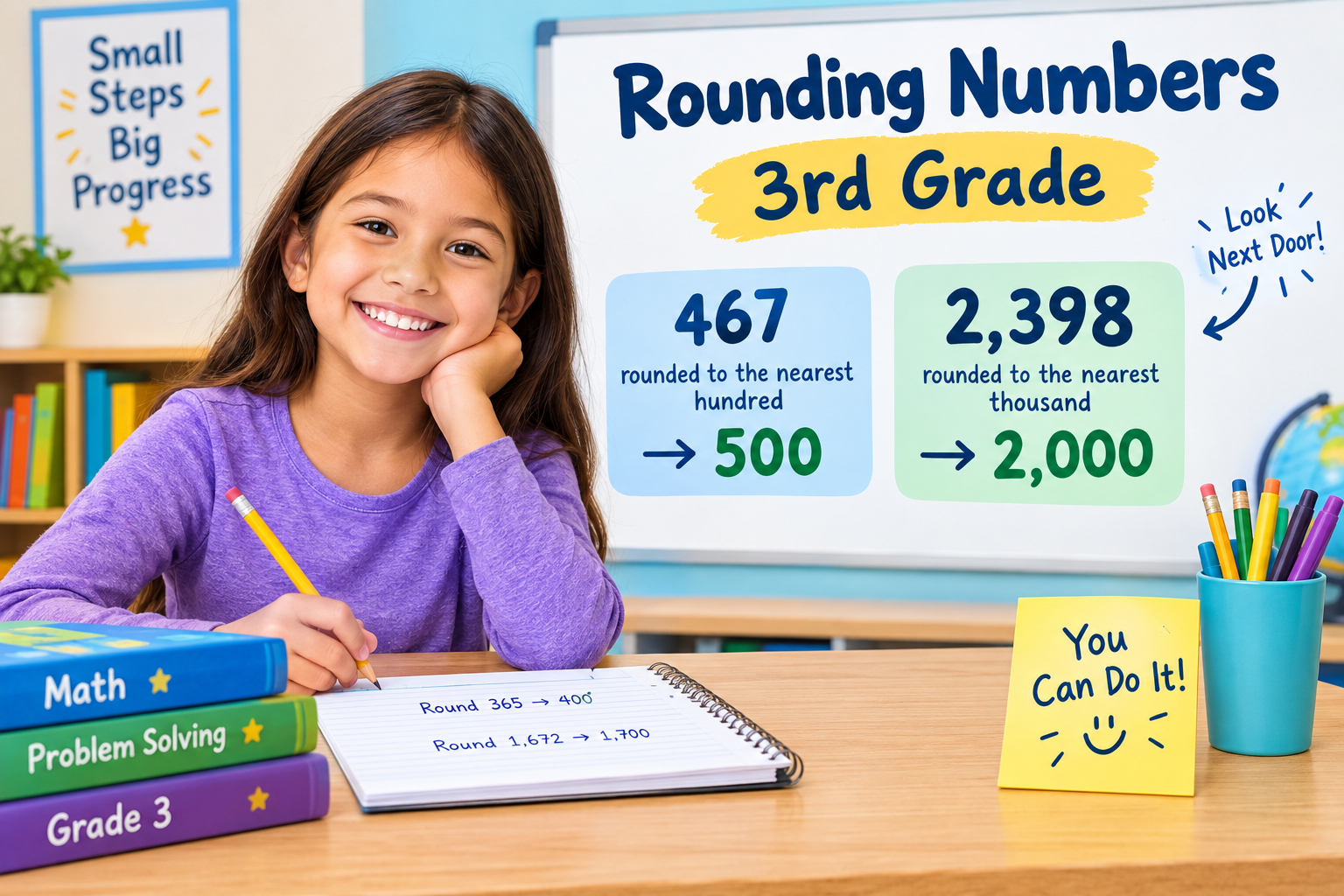
Rounding numbers helps us replace an exact number with a nearby number that is easier to understand, estimate, or use. In Grade 3, students learn to use their understanding of place value to round whole numbers to the nearest 10 or 100.
For example: 34 rounds to 30; 67 rounds to 70; 241 rounds to 200; 276 rounds to 300.
The key is learning which digit to look at and understanding why that digit tells us whether to round up or down. This complete guide covers vocabulary, rules, number lines, worked examples, real-world applications, common mistakes, practice, word problems, and a complete answer key.
Quick Learning Map
- What is rounding?
- Why do we round numbers?
- Important rounding vocabulary
- Place value and rounding
- Rounding to the nearest 10
- Rounding to the nearest 100
- Using a number line
- Using the look-next-door strategy
- Worked examples
- Visual models
- Real-life applications
- Common mistakes
- Word-problem strategies
- Practice questions
- Challenge problems
- Quick quiz
- Parent and teacher activities
- Related Grade 3 math topics
- Frequently asked questions
- Quick review
- Final practice challenge
Common Core Alignment
CCSS 3.NBT.A.1
Use place value understanding to round whole numbers to the nearest 10 or 100.
In simple language: A Grade 3 student should be able to look at a whole number, understand its place values, and determine the closest multiple of 10 or 100.
This article supports the standard by teaching students to identify place values, find the digit that controls rounding, round to the nearest 10 and 100, use number lines, apply rounding to real-world situations, and explain why an answer is correct.
Math Vocabulary
| Term | Simple Definition | Example |
| Round | Change a number to a nearby number that is easier to use. | 47 → 50 |
| Rounding | The process of finding a nearby number. | 83 → 80 |
| Place value | The value of a digit based on its position. | 6 in 64 means 60 |
| Ones place | The place immediately to the right of the tens place. | 47 → 7 |
| Tens place | The second digit from the right. | 47 → 4 |
| Hundreds place | The third digit from the right. | 347 → 3 |
| Nearest 10 | The closest multiple of 10. | 63 → 60 |
| Nearest 100 | The closest multiple of 100. | 263 → 300 |
| Digit | One symbol used to write a number. | 5 is a digit |
| Number line | A line showing numbers in order. | 40 — 50 — 60 |
| Estimate | A number that is close to the exact answer. | About 50 |
| Multiple | A number made by multiplying a whole number. | 10, 20, 30 |
Core Concepts
What Is Rounding?
Rounding means replacing a number with a nearby number that is easier to use. Suppose you have 48. The nearest tens are 40 and 50. Because 48 is closer to 50, 48 rounds to 50.
Why Do We Round Numbers?
Rounding is useful when we don’t need an exact number. For example, if a classroom library has exactly 487 books, saying about 500 books may be more useful for a quick estimate.
- Estimate quickly.
- Check whether an answer makes sense.
- Understand large quantities.
- Make mental calculations easier.
- Describe measurements approximately.
Place Value: The Foundation of Rounding
Consider 4,582: 4 thousands, 5 hundreds, 8 tens, and 2 ones. When rounding to the nearest 10, we care about the tens place and look at the ones digit. When rounding to the nearest 100, we care about the hundreds place and look at the tens digit.
Rounding to the Nearest 10
Steps are following –
1: Find the tens digit.
2: Look at the ones digit.
3: If the ones digit is 0–4, round down; if it is 5–9, round up.
4: Change the ones digit to 0.
Examples: 43 → 40 because the ones digit is 3. 47 → 50 because the ones digit is 7.
Helpful rule: 4 or less, let it rest. 5 or more, raise the score.
Rounding to the Nearest 100
When rounding to the nearest 100, look at the tens digit. For 327, the tens digit is 2, so 327 → 300. For 376, the tens digit is 7, so 376 → 400.
The Look-Next-Door Strategy
When rounding to the nearest 10, look at the ones digit. When rounding to the nearest 100, look at the tens digit. The digit to the right tells you whether to round down or up.
Number Line Strategy
For 36, the nearest tens are 30 and 40. Since 36 is closer to 40, it rounds to 40. For 72, the nearest tens are 70 and 80. Since 72 is closer to 70, it rounds to 70.
The midpoint matters: between 30 and 40, the halfway point is 35. Numbers 31–34 round to 30, while 35–39 round to 40 under the standard convention used here.
Visual Learning Suggestions
Place-Value Chart
What should appear: Show hundreds, tens, and ones for a number such as 374; highlight the rounding place and point to the digit immediately to its right.
Explanation: The right-hand digit tells whether the rounding digit stays the same or increases.
Number Line
What should appear: Show 60 — 65 — 70 with 64 marked between 60 and 70.
Explanation: 64 is closer to 60, so it rounds to 60.
Rounding 67
What should appear: Show 60 — 65 — 70 with 67 marked near 70.
Explanation: 67 is closer to 70, so it rounds to 70.
Nearest 100
What should appear: Show 300 — 350 — 400 with 326 marked between 300 and 350.
Explanation: 326 is below the midpoint, so it rounds to 300.
Place-Value Arrow
What should appear: Show 583 and an arrow from the hundreds place to the tens digit.
Explanation: The tens digit is 8, so 583 rounds up to 600.
Worked Examples
1. Round 24 to the nearest 10.
Step-by-step: Tens digit = 2; ones digit = 4; 4 is less than 5; therefore 24 → 20.
Answer: therefore 24 → 20.
Why it works: 24 is closer to 20 than 30.
2. Round 68 to the nearest 10.
Step-by-step: Tens digit = 6; ones digit = 8; 8 is 5 or greater; therefore 68 → 70.
Answer: therefore 68 → 70.
Why it works: 68 is closer to 70 than 60.
3. Round 132 to the nearest 10.
Step-by-step: Tens digit = 3; ones digit = 2; round down; 132 → 130.
Answer: 132 → 130.
Why it works: 132 is closer to 130 than 140.
4. Round 157 to the nearest 10.
Step-by-step: Tens digit = 5; ones digit = 7; round up; 157 → 160.
Answer: 157 → 160.
Why it works: 157 is closer to 160.
5. Round 243 to the nearest 100.
Step-by-step: Hundreds digit = 2; tens digit = 4; round down; 243 → 200.
Answer: 243 → 200.
Why it works: 243 is closer to 200 than 300.
6. Round 268 to the nearest 100.
Step-by-step: Hundreds digit = 2; tens digit = 6; round up; 268 → 300.
Answer: 268 → 300.
Why it works: 268 is closer to 300 than 200.
7. Round 514 to the nearest 10.
Step-by-step: Tens digit = 1; ones digit = 4; round down; 514 → 510.
Answer: 514 → 510.
Why it works: 514 is closer to 510 than 520.
8. Round 586 to the nearest 100.
Step-by-step: Hundreds digit = 5; tens digit = 8; round up; 586 → 600.
Answer: 586 → 600.
Why it works: 586 is closer to 600 than 500.
9. Round 995 to the nearest 10.
Step-by-step: Tens digit = 9; ones digit = 5; round up; 995 → 1,000.
Answer: 995 → 1,000.
Why it works: 995 is halfway between 990 and 1,000, so the standard rule rounds up.
10. Round 749 to the nearest 100.
Step-by-step: Hundreds digit = 7; tens digit = 4; round down; 749 → 700.
Answer: 749 → 700.
Why it works: 749 is 49 away from 700 and 51 away from 800.
11. Round 750 to the nearest 100.
Step-by-step: Hundreds digit = 7; tens digit = 5; round up; 750 → 800.
Answer: 750 → 800.
Why it works: 750 is halfway between 700 and 800 and rounds up.
12. Round 1,249 to the nearest 100.
Step-by-step: Hundreds digit = 2; tens digit = 4; round down; 1,249 → 1,200.
Answer: 1,249 → 1,200.
Why it works: 1,249 is closer to 1,200 than 1,300.
Real-Life Applications
Shopping
$48 of groceries is about $50 to the nearest $10.
Sports
6,782 fans can be described as about 6,800 fans to the nearest 100.
School
392 students is about 400 students to the nearest 100.
Measuring
486 meters is about 500 meters to the nearest 100.
Cooking
98 grams can be described as about 100 grams when an estimate is appropriate.
Common Mistakes
Looking at the wrong digit
For 64 to the nearest 10, do not use the 6. Look at the ones digit, 4. Answer: 60.
Always rounding up
42 does not become 50. The ones digit is 2, so 42 → 40.
Forgetting to change the ones digit to zero
47 does not become 5. It becomes 50.
Confusing nearest 10 and nearest 100
267 → 270 to the nearest 10, but 267 → 300 to the nearest 100.
Thinking 5 rounds down
Using the standard convention here, 5 rounds up: 35 → 40 and 250 → 300.
Forgetting about a new place value
99 → 100 when rounding to the nearest 10.
Rounding before reading the question
Always identify whether the question asks for the nearest 10 or nearest 100.
Problem-Solving Strategies
- Understand the question.
- Identify important information.
- Choose the correct place to round.
- Round step by step.
- Check whether the answer makes sense.
- Explain the answer in a complete sentence.
School Books
A school has 247 books. Nearest 100: tens digit 4, so 247 → 200. Answer: about 200 books.
Sports
A soccer game had 68 spectators. Nearest 10: ones digit 8, so 68 → 70. Answer: about 70 spectators.
Food Cans
A charity collected 1,248 cans. Nearest 100: tens digit 4, so 1,248 → 1,200. Answer: about 1,200 cans.
Practice Section
Easy
- 21 = ______ (nearest 10)
- 34 = ______ (nearest 10)
- 45 = ______ (nearest 10)
- 52 = ______ (nearest 10)
- 67 = ______ (nearest 10)
- 73 = ______ (nearest 10)
- 86 = ______ (nearest 10)
- 91 = ______ (nearest 10)
Medium
- 126 to the nearest 10 = ______
- 143 to the nearest 10 = ______
- 178 to the nearest 10 = ______
- 205 to the nearest 10 = ______
- 234 to the nearest 100 = ______
- 365 to the nearest 100 = ______
- 421 to the nearest 100 = ______
- 589 to the nearest 100 = ______
Challenge
- 395 to the nearest 10 = ______
- 649 to the nearest 100 = ______
- 750 to the nearest 100 = ______
- 995 to the nearest 10 = ______
- 1,249 to the nearest 100 = ______
- 1,751 to the nearest 100 = ______
Word Problems
- A school has 247 books. About how many books are there to the nearest 100?
- A soccer game had 68 spectators. About how many spectators were there to the nearest 10?
- A family spends $93 on groceries. About how much did they spend to the nearest $10?
- A hiking trail is 387 meters long. About how long is the trail to the nearest 100 meters?
- A school event has 524 people attending. About how many people attended to the nearest 100?
Mixed Review
- 46 to the nearest 10 = ______
- 83 to the nearest 10 = ______
- 214 to the nearest 100 = ______
- 267 to the nearest 100 = ______
- 635 to the nearest 10 = ______
Answer Key
Level 1
20, 30, 50, 50, 70, 70, 90, 90
Level 2
130, 140, 180, 210, 200, 400, 400, 600
Level 3
400, 600, 800, 1,000, 1,200, 1,800
Word Problems
- About 200 books. 2. About 70 spectators. 3. About $90. 4. About 400 meters. 5. About 500 people.
Mixed Review
50, 80, 200, 300, 640
Challenge Yourself
- Find three different numbers that round to 50 to the nearest 10. Possible answers: 47, 52, 54.
- A student says 263 rounds to 200 because the ones digit is 3. Explain the error. Correct answer: 300 because the tens digit is 6.
- Which strategy would you use to round 73: number line, place value, or look-next-door? Explain why.
- Can a whole number round to both 40 and 50 when rounding to the nearest 10? Under the standard convention, no; 45 rounds to 50.
Quick Quiz
- Round 34 to the nearest 10. A. 20 B. 30 C. 40 D. 50
- Round 67 to the nearest 10. A. 60 B. 65 C. 70 D. 80
- Round 143 to the nearest 100. A. 100 B. 140 C. 200 D. 300
- Round 276 to the nearest 100. A. 200 B. 250 C. 300 D. 400
- Which digit do you look at when rounding to the nearest 10? A. Hundreds B. Tens C. Ones D. Thousands
- Which digit do you look at when rounding to the nearest 100? A. Ones B. Tens C. Hundreds D. Thousands
- Round 95 to the nearest 10. ______
- Round 425 to the nearest 100. ______
- A school has 186 students. About how many students are there to the nearest 100? ______
- A student says 374 rounds to 400 because the ones digit is 4. Explain whether the student is correct.
Quick Quiz Answer Key
- B — 30; 2. C — 70; 3. A — 100; 4. C — 300; 5. C — Ones; 6. B — Tens; 7. 100; 8. 400; 9. 200; 10. Incorrect. Use the tens digit; 7 means 374 → 400.
Parent & Teacher Tips
- Grocery store estimation: round prices to the nearest $10.
- Number hunt: find numbers on books, signs, receipts, jerseys, or calendars and round them.
- Human number line: physically stand between two multiples of 10 and decide which is closer.
- Rounding card game: draw number cards and round to the teacher’s chosen place.
- Estimate before calculating: predict an approximate answer, then compare it with the exact result.
Related Grade 3 Math Topics
3rd grade place value — Place Value in 3rd Grade: Complete Guide — /3rd-grade-place-value/
comparing numbers — Comparing Numbers in 3rd Grade — /comparing-numbers-3rd-grade/
estimating sums — Estimating Sums in 3rd Grade — /estimating-sums-3rd-grade/
estimating differences — Estimating Differences in 3rd Grade — /estimating-differences-3rd-grade/
addition and subtraction — 3rd Grade Addition and Subtraction — /3rd-grade-addition-subtraction/
multiplication — Multiplication in 3rd Grade — /3rd-grade-multiplication/
division — Division in 3rd Grade — /3rd-grade-division/
number lines — Number Lines for 3rd Grade Math — /number-line-3rd-grade/
3rd grade word problems — 3rd Grade Math Word Problems — /3rd-grade-math-word-problems/
measurement — 3rd Grade Measurement — /3rd-grade-measurement/
FAQs
What is rounding in 3rd grade?
Rounding means changing a number to a nearby number that is easier to use. Grade 3 students commonly round whole numbers to the nearest 10 or 100.
What is the rule for rounding to the nearest 10?
Look at the ones digit. If it is 0–4, round down. If it is 5–9, round up.
What is the rule for rounding to the nearest 100?
Look at the tens digit. If it is 0–4, round down. If it is 5–9, round up.
Why do we look at the digit to the right?
That digit tells us whether the number is closer to the lower or higher multiple.
What happens when the digit is 5?
Using the standard convention in this lesson, a 5 means round up.
Can 99 round to 100?
Yes. 99 rounds to 100 to the nearest 10.
How can a number line help?
It shows the two nearby multiples and lets students see which one is closer.
Is rounding the same as estimating?
No. Rounding is a method for changing a number to a nearby place-value number. Estimation uses close values to find an approximate answer.
What is the most important thing to remember?
Round the place you are asked about, then look one place to the right.
What Common Core standard covers rounding in Grade 3?
CCSS 3.NBT.A.1 covers using place value understanding to round whole numbers to the nearest 10 or 100.
Quick Review: What You Learned
- Rounding gives us a nearby number that is easier to use.
- Grade 3 students use place value to round whole numbers.
- When rounding to the nearest 10, look at the ones digit.
- When rounding to the nearest 100, look at the tens digit.
- Digits 0–4 mean round down.
- Digits 5–9 mean round up.
- A number line can make rounding easier to visualize.
- Rounding can be useful for estimation.
- Always read the question carefully.
- Rounding can help check whether an answer is reasonable.
Final Practice Challenge
A school is organizing a sports day. Every child will receive one bottle of water, so the school bought 286 bottles.
A: Round the number of bottles to the nearest ten.
B: What is the number of bottles when rounded to the nearest hundred?
C: Which rounded number would work better for a quick announcement?
Solution
A: Since the ones digit is 6, 286 rounds up to 290.
B: With 8 in the tens place, 286 rounds up to 300.
C: Because 300 is quicker to say, it suits an announcement better.
Conclusion
Rounding numbers becomes easier when you connect the rule to place value. Remember: round the place you are asked about, and look at the digit immediately to its right. If that digit is 0–4, keep the rounding digit the same. If it is 5–9, increase the rounding digit by 1. Keep practicing with number lines, place-value charts, everyday numbers, and word problems.