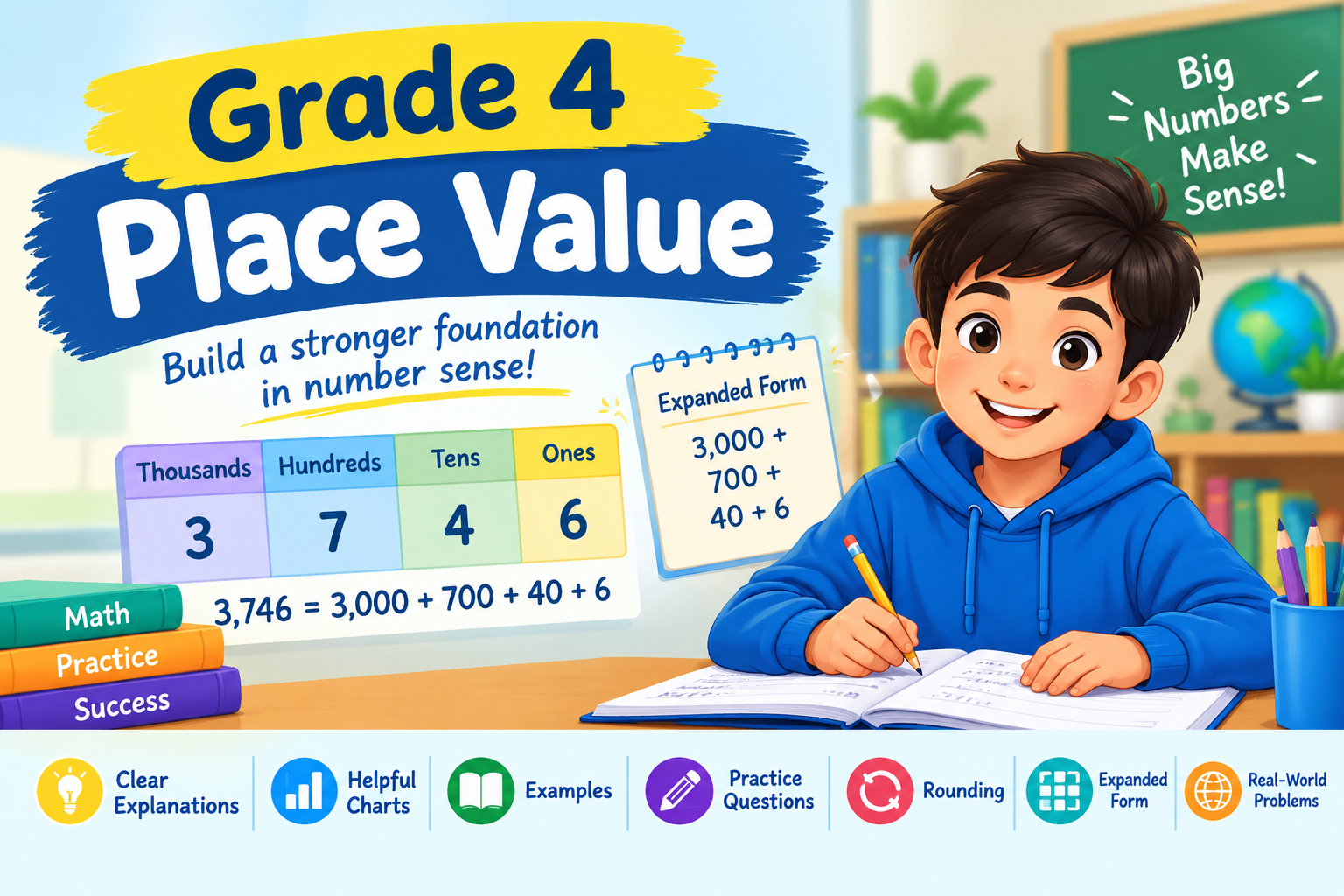
Introduction: What Is Grade 4 Place Value?
Have you ever looked at a number like 45,782 and wondered why the 4 is worth much more than the 2?
The answer is place value.
Place value tells us what each digit in a number is worth based on its position. For example, in 45,782, the digit 4 is in the ten-thousands place, so it represents 40,000. The digit 2 is in the ones place, so it represents 2.
Understanding grade 4 place value is important because it helps you read large numbers, write numbers in different forms, compare numbers, round numbers, and prepare for multi-digit operations.
You can learn this! Take one place at a time, look carefully at each digit, and practice explaining your thinking.
Quick Learning Map
- What is place value?
- Important vocabulary
- The place-value chart
- Reading and writing large numbers
- Standard, word, and expanded forms
- The value of a digit
- Comparing multi-digit numbers
- Ordering numbers
- Rounding numbers
- Step-by-step strategies
- Visual models
- Worked examples
- Real-world applications
- Common mistakes
- Word problems
- Practice exercises
- Challenge problems
- Quick quiz
- Parent and teacher activities
- Quick review
Common Core Alignment
4.NBT.A.1 — Recognize Place Value Relationships
Students recognize that in a multi-digit whole number, a digit in one place represents ten times what it represents in the place to its right.
In simple language: each place is 10 times the value of the place immediately to its right. For example, 1,000 is 10 times 100. This article uses place-value charts and examples to make this relationship clear.
4.NBT.A.2 — Read and Write Multi-Digit Whole Numbers
Students read and write multi-digit whole numbers using standard numerals, number names, and expanded form.
Example: 63,405 = sixty-three thousand four hundred five = 60,000 + 3,000 + 400 + 5.
4.NBT.A.3 — Use Place Value to Round
Students use place value understanding to round multi-digit whole numbers to any place.
Example: 4,682 rounded to the nearest hundred is 4,700. This article teaches the reasoning behind the rounding decision.
Grade 4 Place Value Vocabulary
| Term | Simple Definition | Example |
| Digit | One symbol used to write a number | 7 is a digit |
| Place value | The value a digit has because of its position | 7 in 700 is worth 700 |
| Ones | The first place to the left of the decimal point | 6 in 26 |
| Tens | The place worth groups of ten | 4 in 46 |
| Hundreds | The place worth groups of one hundred | 3 in 326 |
| Thousands | The place worth groups of one thousand | 5 in 5,000 |
| Ten-thousands | Ten groups of 1,000 | 8 in 80,000 |
| Hundred-thousands | One hundred groups of 1,000 | 2 in 200,000 |
| Standard form | A number written using digits | 45,621 |
| Expanded form | A number written as a sum of place values | 40,000 + 5,000 + 600 + 20 + 1 |
| Word form | A number written using words | forty-five thousand… |
| Round | Find a nearby number that is easier to use | 4,682 → 4,700 |
Core Concept 1: Understanding the Place-Value Chart
A Grade 4 student should be comfortable working with numbers through at least the millions.
| Millions | Hundred Thousands | Ten Thousands | Thousands | Hundreds | Tens | Ones |
| 1,000,000 | 100,000 | 10,000 | 1,000 | 100 | 10 | 1 |
Example: 583,241
| Hundred Thousands | Ten Thousands | Thousands | Hundreds | Tens | Ones |
| 5 | 8 | 3 | 2 | 4 | 1 |
Therefore: 583,241 = 500,000 + 80,000 + 3,000 + 200 + 40 + 1.
Why Does Place Value Work?
Our number system is based on groups of 10. Each time we move one place to the left, the value becomes 10 times greater.
- 1 one = 1
- 1 ten = 10
- 1 hundred = 100
- 1 thousand = 1,000
- 1 ten-thousand = 10,000
For example: 10 × 100 = 1,000 and 10 × 1,000 = 10,000.
Core Concept 2: The Value of a Digit
A digit’s value depends on its position. In 77,777, the digit 7 appears five times, but each 7 has a different value.
| Digit | Place | Value |
| 7 | Ten-thousands | 70,000 |
| 7 | Thousands | 7,000 |
| 7 | Hundreds | 700 |
| 7 | Tens | 70 |
| 7 | Ones | 7 |
Example 1: What is the value of 6 in 46,291? Answer: 6,000.
Example 2: What is the value of 6 in 406,291? Answer: 6,000. The 4 is worth 400,000 because it is in the hundred-thousands place.
Core Concept 3: Reading Large Numbers
Commas help us separate numbers into groups. 425,738 is read as “four hundred twenty-five thousand seven hundred thirty-eight.”
2,405,016 is read as “two million four hundred five thousand sixteen.” The zero does not need to be spoken.
Core Concept 4: Standard, Word, and Expanded Form
Standard Form
The number is written using digits: 72,418.
Word Form
The number is written using words: seventy-two thousand four hundred eighteen.
Expanded Form
The number is broken into the value of each digit: 70,000 + 2,000 + 400 + 10 + 8.
Example: 305,624 = 300,000 + 5,000 + 600 + 20 + 4.
Core Concept 5: Zeros in Place Value
Zeros are important because they act as placeholders. In 405,207, the zeros show that there are 0 ten-thousands and 0 tens.
Expanded form: 400,000 + 5,000 + 200 + 7.
Core Concept 6: Comparing Numbers
When comparing numbers, start with the greatest place. Use > for greater than, < for less than, and = for equal to.
Example: 54,321 and 52,999. The ten-thousands digits are equal, but 4 > 2 in the thousands place, so 54,321 > 52,999.
Core Concept 7: Ordering Numbers
To order numbers from least to greatest, compare the greatest place first. If digits match, move one place to the right.
Example: 45,210, 42,999, 46,001, 45,201 → 42,999 < 45,201 < 45,210 < 46,001.
Core Concept 8: Rounding Numbers
Rounding finds a nearby number that is easier to use. Look at the digit immediately to the right of the place you are rounding.
- 0, 1, 2, 3, 4 → stay
- 5, 6, 7, 8, 9 → increase by 1
Example: 4,682 rounded to the nearest hundred is 4,700.
Step-by-Step Strategies
Strategy 1: Find the Value of a Digit
- Locate the digit.
- Identify its place.
- Write the value of that place.
- Multiply the digit by the place value.
Worked example: What is the value of 8 in 281,435? 8 is in the ten-thousands place. 8 × 10,000 = 80,000. Answer: 80,000.
Second example: In 63,712, the 3 is in the thousands place, so its value is 3,000.
Strategy 2: Write a Number in Expanded Form
- Identify each digit.
- Identify its place.
- Find each digit’s value.
- Add the values.
Example: 84,306 = 80,000 + 4,000 + 300 + 6.
Strategy 3: Compare Two Numbers
- Start at the greatest place.
- Compare the digits.
- If they match, move right.
- Stop when you find a difference.
Example: 73,425 and 73,215. The first different digit is in the hundreds place: 4 > 2. Therefore, 73,425 > 73,215.
Strategy 4: Round a Number
- Find the place you’re rounding to.
- Look one place to the right.
- If that digit is 5 or greater, round up.
- If it is 4 or less, keep the digit.
- Change all digits to the right to zeros.
Example: 62,748 rounded to the nearest thousand is 63,000.
Visual Learning Suggestions
| Visual Title | What Should Appear | Short Explanation |
| Grade 4 Place-Value Chart | Millions through Ones with digit columns | Students place digits in columns and identify values. |
| Place-Value Staircase | 1 → 10 → 100 → 1,000 → 10,000 with ×10 arrows | Shows that moving left makes a value 10 times greater. |
| Number 583,241 Decomposed | 583,241 → 500,000 + 80,000 + 3,000 + 200 + 40 + 1 | Connects a number to expanded form. |
| Rounding Number Line | 4,600 ← 4,682 → 4,700 | Shows why 4,682 rounds to 4,700. |
10 Worked Examples
Example 1
Question: What is the value of 5 in 35,214?
1: Find 5.
2: 5 is in the thousands place.
3: 5 × 1,000 = 5,000.
Answer: 5,000
Why it works: The position determines the value.
Example 2
Question: Write 46,203 in expanded form.
1: Find each nonzero digit.
2: 4 = 40,000; 6 = 6,000; 2 = 200.
3: 3 = 3.
Answer: 40,000 + 6,000 + 200 + 3
Why it works: Expanded form shows each place value.
Example 3
Question: Write 72,405 in word form.
1: Read the thousands group.
2: 72 thousand.
3: Read the ones group: 405.
Answer: seventy-two thousand four hundred five
Why it works: The comma separates periods.
Example 4
Question: What is the value of 9 in 394,721?
1: Find 9.
2: 9 is in the ten-thousands place.
3: 9 × 10,000 = 90,000.
Answer: 90,000
Why it works: Each place is ten times the one to its right.
Example 5
Question: Compare 85,426 and 85,624.
1: Compare ten-thousands and thousands.
2: 8 = 8; 5 = 5.
3: Hundreds: 4 < 6.
Answer: 85,426 < 85,624
Why it works: The first different digit decides.
Example 6
Question: Round 34,672 to the nearest thousand.
1: Find the thousands digit.
2: Thousands digit = 4.
3: Hundreds digit = 6, so round up.
Answer: 35,000
Why it works: The hundreds digit controls rounding to the thousand.
Example 7
Question: Order 18,450; 18,405; 19,001; 17,999.
1: Compare thousands groups.
2: 17,999 is smallest.
3: Then order the 18,000 numbers.
Answer: 17,999, 18,405, 18,450, 19,001
Why it works: Compare from the greatest place.
Example 8
Question: Find 300,000 + 40,000 + 2,000 + 500 + 8.
1: Combine place values.
2: 300,000 + 40,000 = 340,000.
3: Add 2,000 + 500 + 8.
Answer: 342,508
Why it works: Expanded form represents each place.
Example 9
Question: Round 695,481 to the nearest ten thousand.
1: Find the ten-thousands digit.
2: It is 9.
3: Thousands digit is 5, causing 9 to roll over.
Answer: 700,000
Why it works: Rounding can cause regrouping.
Example 10
Question: Find the number with 6 hundred-thousands, 3 thousands, 8 hundreds, and 4 ones.
1: Write each place value.
2: 600,000 + 3,000.
3: Add 800 + 4.
Answer: 603,804
Why it works: Zeros hold empty places.
Real-Life Applications
Shopping
A store sells $12,450 worth of products in one day. Place value helps identify ten-thousands, thousands, hundreds, tens, and ones.
Sports
A stadium has 54,600 seats. Students can identify the value of each digit or round the capacity.
School
A school district has 28,475 students. Rounding can give a quick estimate: 28,475 → 28,000 to the nearest thousand.
Games
A player earns 125,680 points. Place value helps compare that score with another player’s score.
Common Mistakes
Thinking a digit always has the same value
Incorrect thinking: “The 7 is worth 7.”
Why it is wrong: In 7,000, 7 is worth 7,000.
Correct approach: Always ask what place the digit is in.
Forgetting zeroes
Incorrect thinking: 405,207 becomes 45,27.
Why it is wrong: Zeroes hold places.
Correct approach: Keep every placeholder in the correct column.
Comparing from the ones place
Incorrect thinking: Comparing the last digits first.
Why it is wrong: The greatest place has the most information.
Correct approach: Start at the leftmost place.
Rounding the wrong digit
Incorrect thinking: Looking at the target digit instead of the digit to its right.
Why it is wrong: The next digit tells whether to round.
Correct approach: Find the target place, then look one place right.
Forgetting that 5 rounds up
Incorrect thinking: Keeping the digit when the next digit is 5.
Why it is wrong: 5–9 round up.
Correct approach: Use the 0–4 / 5–9 rule.
Misreading expanded form
Incorrect thinking: 45,28 instead of 45,208.
Why it is wrong: Place values must stay aligned.
Correct approach: Write each value in its correct column.
Problem-Solving Strategies for Word Problems
- Understand the question.
- Identify important information.
- Choose the correct operation or place-value strategy.
- Solve step by step.
- Check that the answer makes sense.
- Explain the answer in a complete sentence when appropriate.
Worked Word Problem 1
A library has 46,275 books. Another library has 43,891 books. Which has more? Compare the ten-thousands digits: both are 4. Compare thousands: 6 > 3. Therefore, 46,275 is greater.
Worked Word Problem 2
A school collected 58,462 cans. Round to the nearest thousand. The thousands digit is 8 and the hundreds digit is 4, so keep the 8. Answer: 58,000 cans.
Worked Word Problem 3
A stadium holds 72,500 people and 68,900 tickets are sold. 72,500 − 68,900 = 3,600, so 3,600 more tickets could be sold.
Practice Section
Level 1: Easy
What is the value of 4 in 34,215?
What is the value of 8 in 82,401?
Write 25,306 in expanded form.
and 61,405 in word form.
Write “forty-two thousand eight hundred seven” in standard form.
What place is the 9 in 93,214?
Write 500,000 + 20,000 + 300 + 6 in standard form.
Level 2: Practice
What is the value of 7 in 274,315?
Write 406,521 in expanded form.
Compare: 52,431 ___ 52,341.
Compare: 89,999 ___ 90,001.
Order from least to greatest: 45,201; 44,999; 45,210; 46,001.
Round 34,672 to the nearest thousand.
82,451 to the nearest hundred.
Round 165,432 to the nearest ten thousand.
Level 3: Challenge
What number is represented by 600,000 + 30,000 + 4,000 + 200 + 9?
Round 499,999 to the nearest thousand.
Which is greater: 305,902 or 350,209?
A number has 7 in the hundred-thousands place, 4 in the ten-thousands place, 2 in the thousands place, and 9 in the tens place. What is the number?
Write a number greater than 450,000 but less than 451,000 that has 6 in the hundreds place.
Find two different numbers that round to 50,000 when rounded to the nearest ten thousand.
Word Problems
A city has 324,650 residents. Round the population to the nearest thousand.
A school district has 48,275 students. What is the value of the 8?
A stadium has 76,500 seats. Another stadium has 69,850 seats. Which has more seats?
A company produced 405,620 toys. Write this number in expanded form.
A museum had 92,480 visitors last year. Round this number to the nearest ten thousand.
Mixed Review
Write 708,405 in word form.
What is the value of 7 in 572,631?
Compare 405,600 and 405,060.
Round 349,721 to the nearest thousand.
Write 800,000 + 60,000 + 4,000 + 300 + 20 + 1 in standard form.
Answer Key
Level 1
- 4,000
- 80,000
- 20,000 + 5,000 + 300 + 6
- sixty-one thousand four hundred five
- 42,807
- Ten-thousands place
- 520,306
2 – Level
- 70,000
- 400,000 + 6,000 + 500 + 20 + 1
- 52,431 > 52,341
- 89,999 < 90,001
- 44,999; 45,201; 45,210; 46,001
- 35,000
- 82,500
- 170,000
Level 3
- 634,209
- 500,000
- 350,209
- 742,090
- Example: 450,600
- Examples: 45,000 and 54,000. Both round to 50,000 to the nearest ten thousand.
Word Problems
- 325,000 — 324,650 rounds up because the hundreds digit is 6.
- 8,000 — the 8 is in the thousands place.
- 76,500-seat stadium — 76,500 > 69,850.
- 400,000 + 5,000 + 600 + 20.
- 90,000 — 92,480 rounds to 90,000 to the nearest ten thousand.
Mixed Review
- seven hundred eight thousand four hundred five
- 70,000
- 405,600 > 405,060
- 350,000
- 864,321
Challenge Yourself
Challenge 1: Find More Than One Answer
Find three different numbers that are greater than 30,000, less than 31,000, and round to 30,000 to the nearest thousand. Possible answers: 30,100, 30,400, 30,499.
Challenge 2: Find the Error
A student says, “45,682 rounded to the nearest thousand is 45,000 because the hundreds digit is 6.” Is the student correct? No. The thousands digit is 5 and the hundreds digit is 6, so the answer is 46,000.
Challenge 3: Compare Strategies
Which is better for comparing 67,321 and 67,912: starting with the ones place or the greatest place? Starting with the greatest place is better because place-value comparison finds the first different digit from left to right.
Challenge 4: Create Your Own Number
Create a six-digit number with 5 in the hundred-thousands place, 2 in the thousands place, 7 in the tens place, and a value greater than 520,000. Example: 523,470.
Quick Quiz
- What is the value of 6 in 64,231? A. 6 B. 60 C. 600 D. 60,000
- Which is the expanded form of 35,204? A. 30,000 + 5,000 + 200 + 4 B. 3,000 + 500 + 20 + 4 C. 30,000 + 500 + 20 + 4 D. 35,000 + 204
- Which number is greater? A. 42,315 B. 42,351 C. 41,999 D. 40,999
- Round 56,721 to the nearest thousand. A. 56,000 B. 57,000 C. 56,700 D. 60,000
- Which number has 8 in the ten-thousands place? A. 18,204 B. 81,204 C. 108,204 D. 8,120
- Write 205,430 in expanded form.
- Write seventy-four thousand six hundred nine in standard form.
- What is the value of 3 in 438,521?
- Round 274,600 to the nearest ten thousand.
- A town has 83,450 residents. Another has 79,900. Which has more, and how many more?
Quiz Answer Key
- D — 60,000
- A — 30,000 + 5,000 + 200 + 4
- B — 42,351
- B — 57,000
- A — 18,204
- 200,000 + 5,000 + 400 + 30
- 74,609
- 30,000
- 270,000
- 83,450 has more; 83,450 − 79,900 = 3,550.
Parent & Teacher Tips
- Build numbers with digit cards and ask students to make the largest or smallest number.
- Use real-world numbers such as prices, sports attendance, populations, and scores.
- Play “Round It” by giving a number and a place to round to.
- Create a human place-value chart with students holding digit cards.
- Ask “How do you know?” so students explain their reasoning, not just the answer.
Frequently Asked Questions
What is place value in Grade 4 math?
Place value tells us how much a digit is worth based on its position in a number.
What are the place values in Grade 4?
Students commonly work with ones, tens, hundreds, thousands, ten-thousands, hundred-thousands, and millions.
Why is place value important in Grade 4?
It supports reading, writing, comparing, rounding, and operations with multi-digit numbers.
What is expanded form?
Expanded form breaks a number into the values of its digits. For example, 54,321 = 50,000 + 4,000 + 300 + 20 + 1.
How do you compare two large numbers?
Start at the greatest place and compare digits from left to right until you find the first difference.
How do you round a number?
Find the place you are rounding to and look at the digit immediately to its right. A 5–9 rounds up; a 0–4 stays.
What is the difference between a digit and its value?
A digit is a symbol such as 7. Its value depends on its position; in 7,000, 7 has a value of 7,000.
Why are zeros important in place value?
Zeros act as placeholders and keep other digits in the correct positions.
Quick Review: What You Learned
- A digit’s value depends on its position.
- Each place to the left is 10 times greater than the place to its right.
- Numbers can be written in standard, word, and expanded form.
- Zeroes can act as important placeholders.
- We compare large numbers starting at the greatest place.
- We can order numbers from least to greatest or greatest to least.
- We use place value when rounding numbers.
- A number line can help us understand rounding.
- Place value is useful in real-world situations involving money, populations, scores, and measurements.
- Explaining why an answer works is an important part of mathematical thinking.
Final Practice Challenge
A city has 486,725 residents. Another city has 479,890 residents.
- Which city has more residents?
- What is the value of the digit 8 in 486,725?
- Write 486,725 in expanded form.
- Round 486,725 to the nearest thousand.
- How many more residents does the larger city have?
- Write a sentence explaining how place value helped you solve the problem.
Solution
- 486,725 is greater because the ten-thousands digit 8 is greater than 7.
- The 8 is in the ten-thousands place, so its value is 80,000.
- 400,000 + 80,000 + 6,000 + 700 + 20 + 5.
- 487,000, because the hundreds digit is 7.
- 486,725 − 479,890 = 6,835.
- Place value helped compare the numbers and round the larger number correctly.
Keep Practicing!
Place value becomes easier when you practice looking carefully at where each digit lives. When you see a large number, break it into places, identify each digit’s value, and work one step at a time.
1 thought on “Grade 4 Place Value: Easy Guide, Examples, and Practice”