What Students Will Learn
These fifth-grade fraction addition worksheets focus on several important mathematical skills.
1. Adding Fractions With Like Denominators
Fractions with the same denominator are straightforward to add. Students add the numerators and keep the denominator unchanged.
For example:
$\frac{2}{7}+\frac{3}{7}=\frac{5}{7}$
The denominator remains 7 because both fractions describe parts of the same-sized whole.
2. Adding Fractions With Unlike Denominators
When denominators are different, students must first express the fractions using a common denominator.
For example:
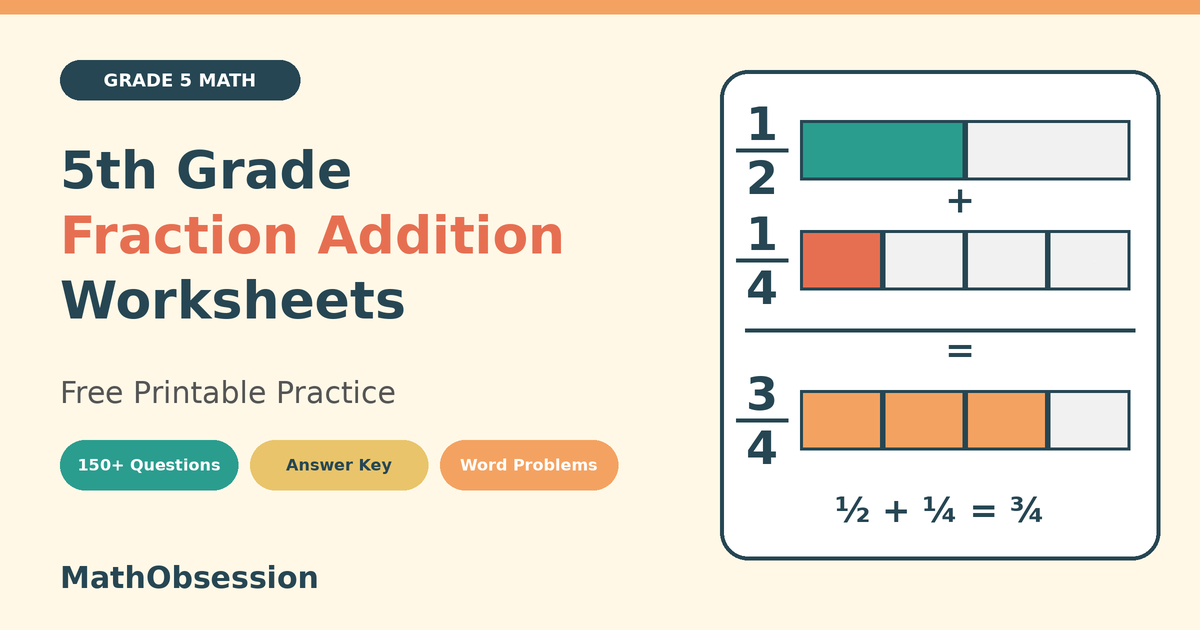
$\frac{1}{2}+\frac{1}{4}=\frac{2}{4}+\frac{1}{4}=\frac{3}{4}$
Equivalent fractions make it possible to combine fractions that originally have different denominators.
3. Simplifying Fraction Sums
Students should express answers in their simplest form when possible.
For example:
$\frac{2}{6}+\frac{1}{6}=\frac{3}{6}=\frac{1}{2}$
Reducing fractions helps students recognize equivalent values and communicate answers clearly.
4. Adding Mixed Numbers
A mixed number contains a whole number and a fraction.
For example:
$1\frac{1}{4}+2\frac{2}{4}=3\frac{3}{4}$
Students can add the whole-number parts and fractional parts separately when that method is convenient.
5. Solving Fraction Word Problems
Fraction addition is useful in everyday situations involving recipes, measurements, distances, reading, and school activities. Word problems help students identify relevant information and decide which fractions to add.
How to Solve Fraction Addition Problems
Follow these steps whenever you add fractions.
- Check whether the denominators are the same.
- If they are the same, add the numerators.
- If they are different, find a common denominator.
- Rewrite the fractions as equivalent fractions.
- Add the numerators while keeping the common denominator.
- Simplify the answer when possible.
- Convert an improper fraction to a mixed number if appropriate.
Worked Example 1: Like Denominators
Add: $\frac{3}{8}+\frac{2}{8}$
Step 1: The denominators are both 8.
Step 2: Add the numerators.
$\frac{3+2}{8}=\frac{5}{8}$
Answer: $\frac{5}{8}$
Worked Example 2: Unlike Denominators
Add: $\frac{1}{3}+\frac{1}{6}$
Step 1: Find a common denominator. Six is a common denominator for 3 and 6.
Step 2: Rewrite the first fraction.
$\frac{1}{3}=\frac{2}{6}$
Step 3: Add the fractions.
$\frac{2}{6}+\frac{1}{6}=\frac{3}{6}$
Step 4: Simplify.
$\frac{3}{6}=\frac{1}{2}$
Answer: $\frac{1}{2}$
Worked Example 3: Adding Mixed Numbers
Add: $2\frac{1}{4}+1\frac{2}{4}$
Add the whole numbers:
$2+1=3$
Add the fractions:
$\frac{1}{4}+\frac{2}{4}=\frac{3}{4}$
Combine the results:
$3+\frac{3}{4}=3\frac{3}{4}$
Answer: $3\frac{3}{4}$
A Helpful Strategy for Unlike Denominators
Students do not always need to multiply the denominators together. They can use the smallest common denominator when it is easy to identify.
For example: $\frac{1}{4}+\frac{1}{6}$
The least common denominator is 12.
$\frac{1}{4}=\frac{3}{12},\qquad \frac{1}{6}=\frac{2}{12}$
Therefore,
$\frac{3}{12}+\frac{2}{12}=\frac{5}{12}$
Students should also estimate their answers. If two fractions are each less than one-half, their sum must be less than one. Estimation can help identify calculation errors.
Grade 5 Fraction Addition Worksheets
The following worksheet collection contains five practice levels. Each section includes 30 questions, giving students 150 opportunities to practice fraction addition.
- Easy Practice: Basic fraction addition and introductory common denominators.
- Medium Practice: Different denominators, simplification, and several calculation steps.
- Advanced Practice: Mixed numbers, missing values, error analysis, and reasoning.
- Mixed Practice: A combination of skills without a predictable question pattern.
- Word Problems: Real-world applications of fraction addition.
Students should show their work when finding common denominators. Writing each step makes it easier to identify errors and explain mathematical thinking.
Easy Practice Questions
Instructions: Add the fractions. Simplify each answer when possible.
- $\frac{1}{5}+\frac{2}{5}=$ ______
- $\frac{2}{7}+\frac{3}{7}=$ ______
- $\frac{1}{8}+\frac{4}{8}=$ ______
- $\frac{3}{10}+\frac{2}{10}=$ ______
- $\frac{2}{9}+\frac{5}{9}=$ ______
- $\frac{1}{6}+\frac{2}{6}=$ ______
- $\frac{4}{12}+\frac{3}{12}=$ ______
- $\frac{3}{8}+\frac{3}{8}=$ ______
- $\frac{2}{11}+\frac{6}{11}=$ ______
- $\frac{5}{12}+\frac{4}{12}=$ ______
- $\frac{1}{2}+\frac{1}{2}=$ ______
- $\frac{1}{4}+\frac{2}{4}=$ ______
- $\frac{1}{3}+\frac{1}{3}=$ ______
- $\frac{2}{6}+\frac{1}{6}=$ ______
- $\frac{3}{5}+\frac{1}{5}=$ ______
- $\frac{1}{2}+\frac{1}{4}=$ ______
- $\frac{1}{3}+\frac{1}{6}=$ ______
- $\frac{1}{4}+\frac{1}{8}=$ ______
- $\frac{1}{2}+\frac{1}{8}=$ ______
- $\frac{1}{5}+\frac{2}{10}=$ ______
- $\frac{1}{3}+\frac{1}{9}=$ ______
- $\frac{1}{6}+\frac{1}{3}=$ ______
- $\frac{2}{5}+\frac{1}{10}=$ ______
- $\frac{3}{4}+\frac{1}{8}=$ ______
- $\frac{2}{3}+\frac{1}{6}=$ ______
- $\frac{1}{4}+\frac{1}{6}=$ ______
- $\frac{2}{7}+\frac{1}{14}=$ ______
- $\frac{3}{10}+\frac{1}{5}=$ ______
- $\frac{1}{8}+\frac{3}{16}=$ ______
- $\frac{2}{9}+\frac{1}{3}=$ ______
Medium Practice Questions
Instructions: Find a common denominator, add the fractions, and simplify.
- $\frac{2}{3}+\frac{3}{4}=$ ______
- $\frac{3}{5}+\frac{2}{7}=$ ______
- $\frac{5}{6}+\frac{1}{4}=$ ______
- $\frac{3}{8}+\frac{5}{12}=$ ______
- $\frac{7}{10}+\frac{2}{15}=$ ______
- $\frac{4}{9}+\frac{5}{6}=$ ______
- $\frac{5}{8}+\frac{7}{16}=$ ______
- $\frac{2}{5}+\frac{5}{12}=$ ______
- $\frac{7}{12}+\frac{5}{18}=$ ______
- $\frac{3}{7}+\frac{2}{9}=$ ______
- $\frac{5}{14}+\frac{3}{7}=$ ______
- $\frac{7}{15}+\frac{1}{6}=$ ______
- $\frac{5}{9}+\frac{7}{12}=$ ______
- $\frac{11}{20}+\frac{3}{10}=$ ______
- $\frac{5}{16}+\frac{7}{24}=$ ______
- $\frac{2}{3}+\frac{5}{8}=$ ______
- $\frac{7}{18}+\frac{5}{12}=$ ______
- $\frac{4}{5}+\frac{7}{20}=$ ______
- $\frac{5}{6}+\frac{7}{15}=$ ______
- $\frac{3}{10}+\frac{7}{12}=$ ______
- $1\frac{1}{4}+2\frac{2}{4}=$ ______
- $2\frac{1}{3}+1\frac{1}{3}=$ ______
- $1\frac{1}{2}+2\frac{1}{4}=$ ______
- $3\frac{2}{5}+1\frac{1}{5}=$ ______
- $2\frac{3}{8}+1\frac{1}{8}=$ ______
- $1\frac{2}{3}+2\frac{1}{6}=$ ______
- $2\frac{3}{4}+\frac{1}{2}=$ ______
- $1\frac{5}{6}+\frac{1}{3}=$ ______
- $3\frac{1}{4}+2\frac{1}{2}=$ ______
- $4\frac{2}{7}+1\frac{3}{7}=$ ______
Advanced Practice Questions
Instructions: Solve carefully. Show your work for missing-number problems and explain any corrections.
- $\frac{5}{6}+\frac{7}{9}=$ ______
- $\frac{7}{12}+\frac{5}{8}=$ ______
- $\frac{11}{15}+\frac{7}{10}=$ ______
- $\frac{5}{14}+\frac{11}{21}=$ ______
- $\frac{7}{16}+\frac{5}{12}=$ ______
- $\frac{13}{18}+\frac{7}{24}=$ ______
- $2\frac{5}{6}+1\frac{3}{4}=$ ______
- $3\frac{7}{10}+2\frac{5}{6}=$ ______
- $1\frac{5}{8}+2\frac{7}{12}=$ ______
- $4\frac{2}{9}+1\frac{5}{6}=$ ______
- $2\frac{7}{12}+3\frac{5}{8}=$ ______
- $5\frac{3}{7}+2\frac{5}{14}=$ ______
- $\frac{3}{8}+\square=\frac{7}{8}$
- $\square+\frac{2}{5}=\frac{9}{10}$
- $\frac{1}{3}+\square=\frac{5}{6}$
- $2\frac{1}{4}+\square=3$
- $\square+\frac{5}{12}=\frac{11}{12}$
- $1\frac{2}{3}+\square=2\frac{1}{6}$
- A student says $\frac{1}{2}+\frac{1}{3}=\frac{2}{5}$. Explain the error and give the correct answer.
- A student calculates $\frac{2}{5}+\frac{1}{10}=\frac{3}{15}$. Correct the solution.
- Which is greater: $\frac{3}{4}+\frac{1}{8}$ or $\frac{2}{3}+\frac{1}{6}$?
- Is $\frac{5}{8}+\frac{1}{4}$ greater than 1? Explain.
- Find three fractions with denominator 12 whose sum is $\frac{11}{12}$. Each numerator must be a positive whole number.
- Write two different addition equations using fractions that equal $\frac{3}{4}$.
- Find the missing fraction: $\frac{1}{6}+\frac{1}{4}+\square=1$.
- Calculate $1\frac{1}{2}+2\frac{2}{3}+\frac{5}{6}$.
- Calculate $\frac{3}{10}+\frac{2}{5}+\frac{1}{4}$.
- A student adds $\frac{3}{8}+\frac{1}{4}$ and gets $\frac{4}{12}$. Explain the mistake and correct it.
- Find the sum of $\frac{5}{12}$, $\frac{1}{3}$, and $\frac{1}{8}$.
- Mia walks $2\frac{3}{4}$ miles in the morning and $1\frac{5}{6}$ miles in the afternoon. How far does she walk in total?
Mixed Practice Questions
Instructions: Identify the best method for each problem. Simplify your answers.
- $\frac{4}{9}+\frac{2}{9}=$ ______
- $\frac{2}{3}+\frac{1}{8}=$ ______
- $1\frac{1}{4}+2\frac{1}{2}=$ ______
- $\frac{5}{12}+\frac{1}{6}=$ ______
- $\frac{7}{10}+\frac{3}{5}=$ ______
- $\frac{1}{4}+\frac{1}{5}=$ ______
- $3\frac{2}{7}+1\frac{4}{7}=$ ______
- $\frac{5}{8}+\frac{3}{16}=$ ______
- $\frac{2}{5}+\square=\frac{9}{10}$
- $\frac{7}{12}+\frac{1}{8}=$ ______
- $2\frac{3}{4}+\frac{3}{8}=$ ______
- $\frac{5}{6}+\frac{2}{9}=$ ______
- $\frac{3}{7}+\frac{2}{7}+\frac{1}{7}=$ ______
- $\frac{1}{2}+\frac{1}{3}+\frac{1}{6}=$ ______
- $4\frac{1}{5}+2\frac{3}{10}=$ ______
- $\frac{7}{15}+\frac{2}{5}=$ ______
- $\frac{5}{9}+\frac{1}{6}=$ ______
- $1\frac{7}{8}+2\frac{1}{4}=$ ______
- Which is greater: $\frac{2}{3}+\frac{1}{12}$ or $\frac{3}{4}$?
- $\frac{3}{10}+\frac{7}{20}+\frac{1}{4}=$ ______
- $\square+\frac{3}{8}=\frac{7}{8}$
- $2\frac{2}{3}+1\frac{5}{6}=$ ______
- $\frac{11}{16}+\frac{1}{8}=$ ______
- $\frac{4}{5}+\frac{1}{15}=$ ______
- A recipe needs $\frac{2}{3}$ cup of flour and $\frac{3}{4}$ cup of flour. Find the total.
- $\frac{5}{12}+\frac{5}{18}=$ ______
- $3\frac{5}{6}+\frac{2}{3}=$ ______
- $\frac{7}{8}+\frac{1}{16}=$ ______
- $\frac{1}{4}+\frac{2}{3}+\frac{1}{12}=$ ______
- Explain why $\frac{2}{7}+\frac{3}{7}=\frac{5}{7}$, not $\frac{5}{14}$.
Fraction Addition Word Problems
Instructions: Read each problem carefully. Write an equation and solve it. Include units when needed.
- Emma drinks $\frac{2}{5}$ liter of water in the morning and $\frac{1}{5}$ liter in the afternoon. How much water does she drink altogether?
- A recipe requires $\frac{3}{4}$ cup of milk and $\frac{1}{2}$ cup of water. What is the total liquid measurement?
- Noah reads $\frac{2}{7}$ of a book on Monday and $\frac{3}{7}$ on Tuesday. What fraction of the book does he read?
- A hiking trail has one section that is $2\frac{1}{4}$ miles long and another that is $1\frac{1}{2}$ miles long. What is the combined distance?
- A baker uses $\frac{2}{3}$ pound of flour for bread and $\frac{1}{4}$ pound for rolls. How much flour is used?
- Olivia paints $\frac{3}{8}$ of a wall before lunch and $\frac{1}{4}$ after lunch. What fraction of the wall does she paint?
- A runner travels $1\frac{2}{5}$ miles in the morning and $2\frac{1}{5}$ miles in the evening. Find the total distance.
- A garden has $\frac{2}{9}$ of its area planted with carrots and $\frac{4}{9}$ planted with tomatoes. What fraction is planted with these vegetables?
- Liam spends $\frac{1}{3}$ hour on math homework and $\frac{1}{4}$ hour on reading. How much time does he spend in total?
- A bottle contains $\frac{5}{6}$ gallon of juice. Another bottle contains $\frac{1}{3}$ gallon. What is the combined amount?
- A student completes $\frac{3}{10}$ of a project on Monday and $\frac{4}{10}$ on Tuesday. What fraction is completed?
- A carpenter cuts one board that is $2\frac{1}{3}$ feet long and another that is $1\frac{1}{6}$ feet long. What is their combined length?
- A family drives $45\frac{1}{2}$ miles in the morning and $32\frac{1}{4}$ miles in the afternoon. How far do they drive altogether?
- A pitcher contains $\frac{3}{5}$ liter of lemonade. A second pitcher contains $\frac{7}{10}$ liter. How much lemonade is there altogether?
- A student practices piano for $\frac{5}{8}$ hour on Saturday and $\frac{3}{8}$ hour on Sunday. How much does the student practice?
Addition Word Problems
- A recipe uses $1\frac{1}{2}$ cups of oats and $\frac{3}{4}$ cup of raisins. What is the sum of these measurements?
- A cyclist rides $3\frac{2}{5}$ miles before a break and $2\frac{3}{10}$ miles afterward. What is the total distance?
- A class collects $\frac{2}{5}$ of a box of canned goods in the morning and $\frac{3}{10}$ of a box later. How much do they collect?
- A ribbon is $4\frac{1}{8}$ feet long. Another ribbon is $2\frac{3}{4}$ feet long. What is their combined length?
- Ava reads $\frac{1}{6}$ of a novel on Friday, $\frac{1}{3}$ on Saturday, and $\frac{1}{4}$ on Sunday. What fraction does she read over the three days?
- A school garden has $\frac{1}{4}$ of its area planted with flowers and $\frac{2}{5}$ planted with vegetables. What fraction is planted with flowers or vegetables?
- A water tank receives $12\frac{1}{2}$ gallons in one delivery and $8\frac{3}{4}$ gallons in another. How much water is delivered?
- A student walks $\frac{3}{4}$ mile to the library and $\frac{5}{6}$ mile to a park afterward. What is the total distance?
- A baker mixes $2\frac{2}{3}$ cups of flour with $1\frac{5}{6}$ cups of flour. What is the total amount?
- A baseball player completes $\frac{2}{8}$ of a fitness routine in the morning and $\frac{3}{8}$ in the afternoon. What fraction is completed?
- A family uses $1\frac{3}{4}$ pounds of apples for a pie and $2\frac{1}{2}$ pounds for snacks. How many pounds do they use?
- A hiker walks $\frac{5}{12}$ mile on a flat path and $\frac{7}{18}$ mile on a hill. What is the total distance?
- A school fundraiser earns 125.50 dollars on Monday and 84.25 dollars on Tuesday. What is the total amount raised?
- A student spends $1\frac{1}{3}$ hours studying science and $\frac{5}{6}$ hour studying history. How long does the student study altogether?
- A container has $3\frac{1}{4}$ gallons of water. Another container has $2\frac{5}{8}$ gallons. How much water is there in total?
Complete Answer Key
Easy Practice Answers
- $\frac{3}{5}$
- $\frac{5}{7}$
- $\frac{5}{8}$
- $\frac{1}{2}$
- $\frac{7}{9}$
- $\frac{1}{2}$
- $\frac{7}{12}$
- $\frac{3}{4}$
- $\frac{8}{11}$
- $\frac{3}{4}$
- $1$
- $\frac{3}{4}$
- $\frac{2}{3}$
- $\frac{1}{2}$
- $\frac{4}{5}$
- $\frac{3}{4}$
- $\frac{1}{2}$
- $\frac{3}{8}$
- $\frac{5}{8}$
- $\frac{2}{5}$
- $\frac{4}{9}$
- $\frac{1}{2}$
- $\frac{1}{2}$
- $\frac{7}{8}$
- $\frac{5}{6}$
- $\frac{5}{12}$
- $\frac{5}{14}$
- $\frac{1}{2}$
- $\frac{5}{16}$
- $\frac{5}{9}$
Medium Practice Answers
- $1\frac{5}{12}$
- $\frac{31}{35}$
- $1\frac{1}{12}$
- $\frac{19}{24}$
- $\frac{5}{6}$
- $1\frac{5}{18}$
- $1\frac{1}{16}$
- $\frac{49}{60}$
- $\frac{31}{36}$
- $\frac{41}{63}$
- $\frac{11}{14}$
- $\frac{19}{30}$
- $1\frac{5}{36}$
- $\frac{17}{20}$
- $\frac{29}{48}$
- $1\frac{7}{24}$
- $\frac{29}{36}$
- $1\frac{3}{20}$
- $1\frac{3}{10}$
- $\frac{53}{60}$
- $3\frac{3}{4}$
- $3\frac{2}{3}$
- $3\frac{3}{4}$
- $4\frac{3}{5}$
- $3\frac{1}{2}$
- $3\frac{5}{6}$
- $3\frac{1}{4}$
- $2\frac{1}{6}$
- $5\frac{3}{4}$
- $5\frac{5}{7}$
Advanced Practice Answers
- $1\frac{11}{18}$
- $1\frac{5}{24}$
- $1\frac{13}{30}$
- $\frac{37}{42}$
- $\frac{41}{48}$
- $1\frac{1}{72}$
- $4\frac{7}{12}$
- $6\frac{8}{15}$
- $4\frac{5}{24}$
- $6\frac{1}{18}$
- $6\frac{5}{24}$
- $7\frac{11}{14}$
- $\frac{1}{2}$
- $\frac{1}{2}$
- $\frac{1}{2}$
- $\frac{3}{4}$
- $\frac{1}{2}$
- $\frac{1}{2}$
- The denominators cannot be added directly. Use sixths: $\frac{1}{2}=\frac{3}{6}$ and $\frac{1}{3}=\frac{2}{6}$. The correct sum is $\frac{5}{6}$.
- $\frac{2}{5}=\frac{4}{10}$, so the sum is $\frac{4}{10}+\frac{1}{10}=\frac{5}{10}=\frac{1}{2}$.
- The first sum is $\frac{7}{8}$; the second is $\frac{5}{6}$. The first is greater.
- $\frac{5}{8}+\frac{1}{4}=\frac{7}{8}$, which is less than 1.
- One possible answer is $\frac{2}{12}+\frac{4}{12}+\frac{5}{12}=\frac{11}{12}$.
- Examples: $\frac{1}{2}+\frac{1}{4}=\frac{3}{4}$ and $\frac{1}{8}+\frac{5}{8}=\frac{3}{4}$.
- $\frac{7}{12}$, because $1-\frac{1}{6}-\frac{1}{4}=\frac{7}{12}$.
- $5$, because $1\frac{1}{2}+2\frac{2}{3}+\frac{5}{6}=\frac{3}{2}+\frac{8}{3}+\frac{5}{6}=5$.
- $\frac{19}{20}$
- The fractions need a common denominator. $\frac{1}{4}=\frac{2}{8}$, so $\frac{3}{8}+\frac{2}{8}=\frac{5}{8}$.
- $\frac{7}{8}$
- $4\frac{7}{12}$ miles.
Mixed Practice Answers
- $\frac{2}{3}$
- $\frac{19}{24}$
- $3\frac{3}{4}$
- $\frac{7}{12}$
- $1\frac{3}{10}$
- $\frac{9}{20}$
- $4\frac{6}{7}$
- $\frac{13}{16}$
- $\frac{1}{2}$
- $\frac{17}{24}$
- $3\frac{1}{8}$
- $1\frac{1}{18}$
- $\frac{6}{7}$
- $1$
- $6\frac{1}{2}$
- $\frac{13}{15}$
- $\frac{13}{18}$
- $4\frac{1}{8}$
- They are equal: both equal $\frac{3}{4}$.
- $\frac{9}{10}$
- $\frac{1}{2}$
- $4\frac{1}{2}$
- $\frac{13}{16}$
- $\frac{13}{15}$
- $1\frac{5}{12}$ cups
- $\frac{25}{36}$
- $4\frac{1}{2}$
- $\frac{15}{16}$
- $1$
- The denominators represent equal-sized parts. Add the numerators and keep the denominator: $\frac{2}{7}+\frac{3}{7}=\frac{5}{7}$.
Word Problem Answers
- $\frac{3}{5}$ liter
- $1\frac{1}{4}$ cups
- $\frac{5}{7}$ of the book
- $3\frac{3}{4}$ miles
- $\frac{11}{12}$ pound
- $\frac{5}{8}$ of the wall
- $3\frac{3}{5}$ miles
- $\frac{2}{3}$ of the garden
- $\frac{7}{12}$ hour, or 35 minutes
- $1\frac{1}{6}$ gallons
- $\frac{7}{10}$ of the project
- $3\frac{1}{2}$ feet
- $77\frac{3}{4}$ miles
- $1\frac{3}{10}$ liters
- $1$ hour
- $2\frac{1}{4}$ cups
- $5\frac{7}{10}$ miles
- $\frac{7}{10}$ of a box
- $6\frac{7}{8}$ feet
- $\frac{3}{4}$ of the novel
- $\frac{13}{20}$ of the garden
- $21\frac{1}{4}$ gallons
- $1\frac{7}{12}$ miles
- $4\frac{1}{2}$ cups
- $\frac{5}{8}$ of the routine
- $4\frac{1}{4}$ pounds
- $\frac{29}{36}$ mile
- 75 dollars
- $2\frac{1}{6}$ hours
- $5\frac{7}{8}$ gallons
Tips for Parents and Teachers
- Start with understanding. Before introducing common denominators, make sure students understand that fractions represent parts of a whole. Fraction strips, drawings, and number lines can make this idea easier to understand.
- Teach one strategy at a time. Begin with like denominators, then introduce equivalent fractions and common denominators. Move to mixed numbers after students become comfortable with the basic procedure.
- Encourage students to show their work. A correct answer is important, but the steps explain whether students understand the process. Ask them to identify the common denominator and show the equivalent fractions.
- Review errors constructively. If a student adds both numerators and denominators, use a visual model to explain why the denominator represents the size of the pieces rather than the number of pieces.
- Use short, regular practice sessions. A manageable set of questions can help students develop confidence without becoming overwhelmed. Choose a section that matches the student’s current level.
- Separate practice from checking. Let students complete a worksheet before looking at the answer key. Ask them to correct mistakes and explain the correction in their own words.
- Use real-world examples. Recipes, distances, classroom projects, and reading schedules help students understand why fraction addition matters beyond a math lesson.
- Provide appropriate challenges. Students who master basic calculations can move on to mixed numbers, missing values, and multistep word problems.
Frequently Asked Questions
1. What should a fifth grader know about adding fractions?
Fifth graders should learn to add fractions with unlike denominators by finding common denominators, create equivalent fractions, and solve word problems involving fraction addition. They should also practice adding fractions whose sums exceed one whole.
2. Are these 5th Grade Fraction Addition Worksheets printable?
Yes. The questions can be copied into a word processor or a WordPress page and printed. US Letter paper is recommended for US classrooms, but A4 is also suitable.
3. Do the worksheets include answers?
Yes. The answer key provides answers for all five practice sections. Selected advanced questions also include explanations to help students understand the reasoning.
4. How can parents help a child who struggles with fraction addition?
Start with visual models, such as fraction strips or drawings. Practice fractions with the same denominator first, then introduce equivalent fractions. Encourage the child to explain each step rather than memorize a procedure without understanding it.
5. How often should students practice fraction addition?
Regular, manageable practice is generally more useful than rushing through a large number of problems in one sitting. Parents and teachers can adjust the number of questions according to the student’s progress and learning needs.
6. Which Common Core standard relates to adding fractions in Grade 5?
The relevant standards include CCSS.MATH.CONTENT.5.NF.A.1, which addresses adding and subtracting fractions with unlike denominators, including mixed numbers, by replacing fractions with equivalent fractions. CCSS.MATH.CONTENT.5.NF.A.2 addresses solving word problems involving addition and subtraction of fractions with unlike denominators. The worksheets provide practice related to these learning expectations.
Final Thoughts
Fraction addition is an essential fifth-grade math skill that supports future learning in fractions, decimals, measurement, and problem-solving. Students become more confident when they understand equivalent fractions, use common denominators correctly, and check whether their answers make sense.
These 5th Grade Fraction Addition Worksheets offer 150 questions across five difficulty levels, along with a complete answer key. Students can begin with easy calculations and gradually progress to mixed numbers, mathematical reasoning, and practical word problems.
Choose the section that best matches your learning goals, show your work, and use the answer key to review mistakes. With consistent practice, students can strengthen their fraction skills and prepare for more advanced mathematics.
Ready for more practice? Explore the related worksheet topics below to continue building fifth-grade math skills.
1 thought on “5th Grade Fraction Addition Worksheets”