Introduction
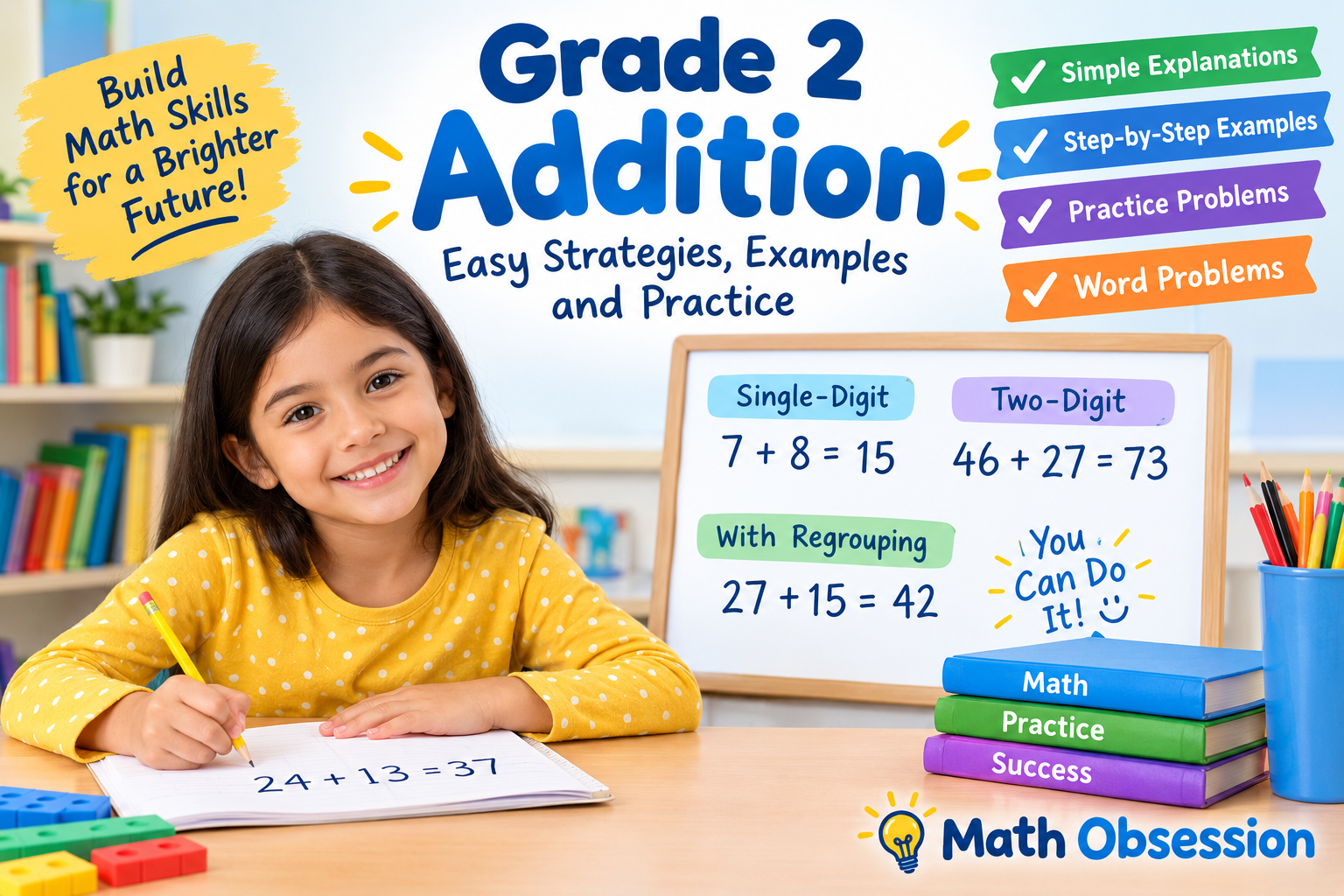
Learning Grade 2 addition helps students become faster and more confident with numbers. By second grade, students are ready to add larger numbers, solve problems with and without regrouping, and use addition in everyday situations.
The good news is that addition does not have to be difficult. When students understand place value and use helpful strategies, they can solve addition problems step by step.
This guide explains Grade 2 addition in simple language and includes examples, tips, word problems, practice problems, and an answer key. Parents and teachers can also use it to support Grade 2 addition practice at home or in the classroom.
What Is Grade 2 Addition?
Addition means putting two or more numbers together to find the total. The answer to an addition problem is called the sum.
For example: 24 + 13 = 37
Here, 24 and 13 are the addends, and 37 is the sum.
The symbol + means “add,” and = means “equals.”
Why Is Addition Important for Grade 2 Students?
Addition helps students find totals, solve money problems, count objects, compare amounts, solve word problems, work with larger numbers, and prepare for subtraction and later math skills.
Key Concepts in Grade 2 Addition
- Adding Within 20
Students should become comfortable adding small numbers.
Examples: 7 + 5 = 12; 9 + 6 = 15; 8 + 8 = 16.
Make a Ten: For 8 + 5, take 2 from 5. 8 + 2 = 10, with 3 left. 10 + 3 = 13. So 8 + 5 = 13.
- Adding Tens and Ones
A two-digit number has a tens place and a ones place. In 47, there are 4 tens and 7 ones, so 47 = 40 + 7.
Example: 32 + 25. Add tens: 30 + 20 = 50. Add ones: 2 + 5 = 7. Combine: 50 + 7 = 57.
- Adding Without Regrouping
Example: 43 + 25. Ones: 3 + 5 = 8. Tens: 40 + 20 = 60. Total: 68.
- Adding With Regrouping
Example: 27 + 15. Ones: 7 + 5 = 12. Regroup 10 ones as 1 ten, leaving 2 ones. Tens: 2 + 1 + 1 = 4. Therefore, 27 + 15 = 42.
Step-by-Step: How to Add Two-Digit Numbers
Example: 46 + 27
Step 1: Line up the place values.
Step 2: Add the ones: 6 + 7 = 13. Write 3 and regroup 1 ten.
Step 3: Add the tens: 4 + 2 + 1 = 7.
Step 4: The answer is 73.
Check: 46 is close to 50 and 27 is close to 30. 50 + 30 = 80, so 73 is a reasonable answer.
Helpful Addition Strategies
Count On: Start with the larger number and count forward. Example: 12 + 4 = 16.
Make a Ten: 9 + 6 = 15 because 9 + 1 = 10 and 5 remain.
Break Apart Numbers: 35 + 24 = 35 + 20 + 4 = 59.
Use an Open Number Line: For 34 + 8, move forward 8 spaces to reach 42.
Use Place Value: 50 + 30 = 80 and 2 + 6 = 8, so 52 + 36 = 88.
Use Doubles: When both addends are the same, use a doubles fact. Example: 6 + 6 = 12.
Use Near Doubles: For 7 + 8, think 7 + 7 = 14, then add 1 more. So 7 + 8 = 15.
Change the Order: Addition can be done in any order. Both 4 + 9 and 9 + 4 equal 13, so students can start with the larger number to make counting on easier.
More Grade 2 Addition Examples
Example 1: 6 + 7 = 13.
Example 2: 21 + 34 = 55.
Example 3: 38 + 24 = 62.
Example 4: 12 + 5 + 8 = 25.
Example 5: A $12 notebook and a $5 pencil case cost $17 altogether.
Common Mistakes in Addition
Mistake 1: Not lining up place values. Put ones under ones and tens under tens.
Mistake 2: Forgetting to regroup when the ones total 10 or more.
Mistake 3: Forgetting the regrouped ten. In 27 + 18, 7 + 8 = 15, so the extra ten must be added to the tens.
Mistake 4: Adding digits from different place values. Always add ones with ones and tens with tens.
Mistake 5: Rushing. Pause and ask whether the answer makes sense.
Helpful Tips and Strategies for Grade 2 Addition Practice
- Start with addition facts you already know.
• Use blocks, coins, buttons, cereal pieces, or pencils.
• Draw pictures when helpful.
• Use a number line.
• Practice a little each day.
• Ask students to explain how they found an answer.
Practice Problems
- 7 + 8 = ___
2. 9 + 5 = ___
3. 6 + 9 = ___
4. 13 + 6 = ___
5. 24 + 13 = ___
6. 35 + 22 = ___
7. 41 + 36 = ___
8. 27 + 18 = ___
9. 46 + 25 = ___
10. 58 + 24 = ___
11. 12 + 7 + 5 = ___
12. 20 + 14 + 6 = ___
13. 39 + 17 = ___
14. 52 + 29 = ___
15. 34 + 28 = ___
Answer Key
- 15
2. 14
3. 15
4. 19
5. 37
6. 57
7. 77
8. 45
9. 71
10. 82
11. 24
12. 40
13. 56
14. 81
15. 62
Word Problems
- Mia has 24 stickers and gets 15 more. 24 + 15 = 39. Mia has 39 stickers.
- A classroom has 32 books on one shelf and 26 on another. 32 + 26 = 58. There are 58 books.
- A farmer picks 37 apples in the morning and 18 in the afternoon. 37 + 18 = 55. The farmer picks 55 apples.
- Jordan scores 28 points in one game and 24 in the next. 28 + 24 = 52. Jordan scores 52 points altogether.
How to Solve Addition Word Problems
- Read the problem carefully.
2. Find the numbers you need.
3. Ask what the problem wants you to find.
4. Decide whether addition is needed.
5. Write an equation.
6. Solve the equation.
7. Write an answer that makes sense.
Helpful clues can include “in all,” “altogether,” “total,” and “combined,” but always read the whole problem.
Optional Challenge Problems
Challenge 1: 47 + 36 = 83.
Challenge 2: Sam has 35 marbles and ends up with 62. 35 + ? = 62, so he gets 27 more marbles.
Challenge 3: 28 + ___ = 50. The missing number is 22.
Extra Practice Sheets
These printable practice sheets give students more chances to build speed and confidence. Each sheet focuses on one skill, so teachers and parents can choose the sheet that matches what a student needs most. Answers for every sheet are at the end of this section.
How to Use These Practice Sheets
- Let students try each sheet on their own before checking any answers.
• Give about 10 minutes for each sheet. Speed is not the goal at first; accuracy is.
• Encourage students to use blocks, drawings, or a number line when a problem feels hard.
• After checking, ask students to explain one problem they got right and one they got wrong.
• Repeat a sheet a few days later and celebrate any improvement in the score.
Suggested One-Week Practice Plan
Monday: Practice Sheet 1 (Adding Within 20)
Tuesday: Practice Sheet 2 (Two-Digit Addition Without Regrouping)
Wednesday: Practice Sheet 3 (Two-Digit Addition With Regrouping)
Thursday: Practice Sheet 4 (Missing Numbers)
Friday: Practice Sheet 5 (Word Problems) and Practice Sheet 6 (Find and Fix the Mistake)
Practice Sheet 1: Adding Within 20
Name: ____________ Date: ____________ Score: ____ / 10
- 8 + 7 = ___
2. 9 + 9 = ___
3. 6 + 8 = ___
4. 5 + 7 = ___
5. 9 + 4 = ___
6. 8 + 6 = ___
7. 7 + 7 = ___
8. 9 + 8 = ___
9. 6 + 6 = ___
10. 4 + 9 = ___
Practice Sheet 2: Two-Digit Addition Without Regrouping
Name: ____________ Date: ____________ Score: ____ / 10
- 21 + 43 = ___
2. 32 + 16 = ___
3. 54 + 23 = ___
4. 60 + 30 = ___
5. 45 + 34 = ___
6. 71 + 18 = ___
7. 52 + 27 = ___
8. 63 + 26 = ___
9. 14 + 55 = ___
10. 80 + 19 = ___
Practice Sheet 3: Two-Digit Addition With Regrouping
Name: ____________ Date: ____________ Score: ____ / 10
- 18 + 25 = ___
2. 27 + 36 = ___
3. 49 + 14 = ___
4. 56 + 27 = ___
5. 38 + 45 = ___
6. 65 + 19 = ___
7. 74 + 18 = ___
8. 29 + 43 = ___
9. 57 + 35 = ___
10. 66 + 24 = ___
Practice Sheet 4: Missing Numbers
Find the number that makes each equation true. Hint: Think about what you need to add to the first number to reach the total.
Name: ____________ Date: ____________ Score: ____ / 8
- 6 + ___ = 14
2. ___ + 8 = 17
3. 23 + ___ = 40
4. 35 + ___ = 52
5. ___ + 27 = 61
6. 48 + ___ = 75
7. 15 + ___ = 33
8. ___ + 19 = 50
Practice Sheet 5: Addition Word Problems
Read each problem carefully. Write an equation, solve it, and write your answer in a full sentence.
Name: ____________ Date: ____________ Score: ____ / 8
- A baker makes 26 cupcakes in the morning and 19 cupcakes in the evening. How many cupcakes does the baker make in all?
2. Rahim reads 14 pages on Monday and 18 pages on Tuesday. How many pages does he read in total?
3. A shop sells 37 red pens and 25 blue pens. How many pens does the shop sell altogether?
4. There are 23 boys and 29 girls in a class. How many students are in the class?
5. Nila saves $15 in January and $28 in February. How much money has she saved?
6. A bus has 34 passengers. Then 17 more passengers get on. How many passengers are on the bus now?
7. Tom collects 12 shells on Saturday, 16 shells on Sunday, and 9 shells on Monday. How many shells does he collect in all?
8. A library has 48 storybooks and 36 science books. How many books does the library have altogether?
Practice Sheet 6: Find and Fix the Mistake
Each student below made a mistake. Find the mistake and write the correct answer.
Name: ____________ Date: ____________ Score: ____ / 4
- Ali says 27 + 18 = 35. What mistake was made? What is the correct answer?
2. Sara says 38 + 24 = 52. What mistake was made? What is the correct answer?
3. Dev says 46 + 25 = 611. What mistake was made? What is the correct answer?
4. Lina says 53 + 29 = 72. What mistake was made? What is the correct answer?
Answer Key for Extra Practice Sheets
Practice Sheet 1: 1. 15, 2. 18, 3. 14, 4. 12, 5. 13, 6. 14, 7. 14, 8. 17, 9. 12, 10. 13
Practice Sheet 2: 1. 64, 2. 48, 3. 77, 4. 90, 5. 79, 6. 89, 7. 79, 8. 89, 9. 69, 10. 99
Practice Sheet 3: 1. 43, 2. 63, 3. 63, 4. 83, 5. 83, 6. 84, 7. 92, 8. 72, 9. 92, 10. 90
Practice Sheet 4: 1. 8, 2. 9, 3. 17, 4. 17, 5. 34, 6. 27, 7. 18, 8. 31
Practice Sheet 5: 1. 45, 2. 32, 3. 62, 4. 52, 5. 43, 6. 51, 7. 37, 8. 84
Practice Sheet 6:
- He forgot to add the regrouped ten. 7 + 8 = 15, so the tens are 2 + 1 + 1 = 4. The correct answer is 45.
2. She forgot the regrouped ten. The correct answer is 62.
3. He wrote 11 in the ones place instead of regrouping. 6 + 5 = 11, so write 1 and regroup 1 ten. The correct answer is 71.
4. She forgot the regrouped ten. 3 + 9 = 12, so the tens are 5 + 2 + 1 = 8. The correct answer is 82.
Frequently Asked Questions
- What should a Grade 2 student know about addition?
Students should be able to add numbers within 20, add two-digit numbers using place value, and solve simple addition word problems. - What is regrouping?
Regrouping means trading 10 ones for 1 ten. - How can my child get better at addition?
Use short, regular practice sessions with games, number lines, and real-life counting. - Should students memorize addition facts?
Knowing common facts helps with speed, but understanding addition and using strategies are also important. - What if my child keeps making mistakes?
Identify the type of mistake. Check place value, alignment, regrouping, and whether the student understands the strategy. - How can teachers make addition practice engaging?
Use games, partner activities, manipulatives, number lines, stories, and real-world problems. - Is it better to add from left to right or right to left?
For the standard written method, students generally start with the ones and then add the tens.
Conclusion
Grade 2 addition is an important foundation for future math learning. Students begin with basic addition facts and build toward adding larger two-digit numbers, including problems that require regrouping.
The most important skills are understanding addition, knowing addition facts, understanding tens and ones, lining up place values, regrouping when needed, using different strategies, solving word problems, and checking whether an answer makes sense.
Regular, focused practice helps students become accurate, flexible, and confident addition problem-solvers.