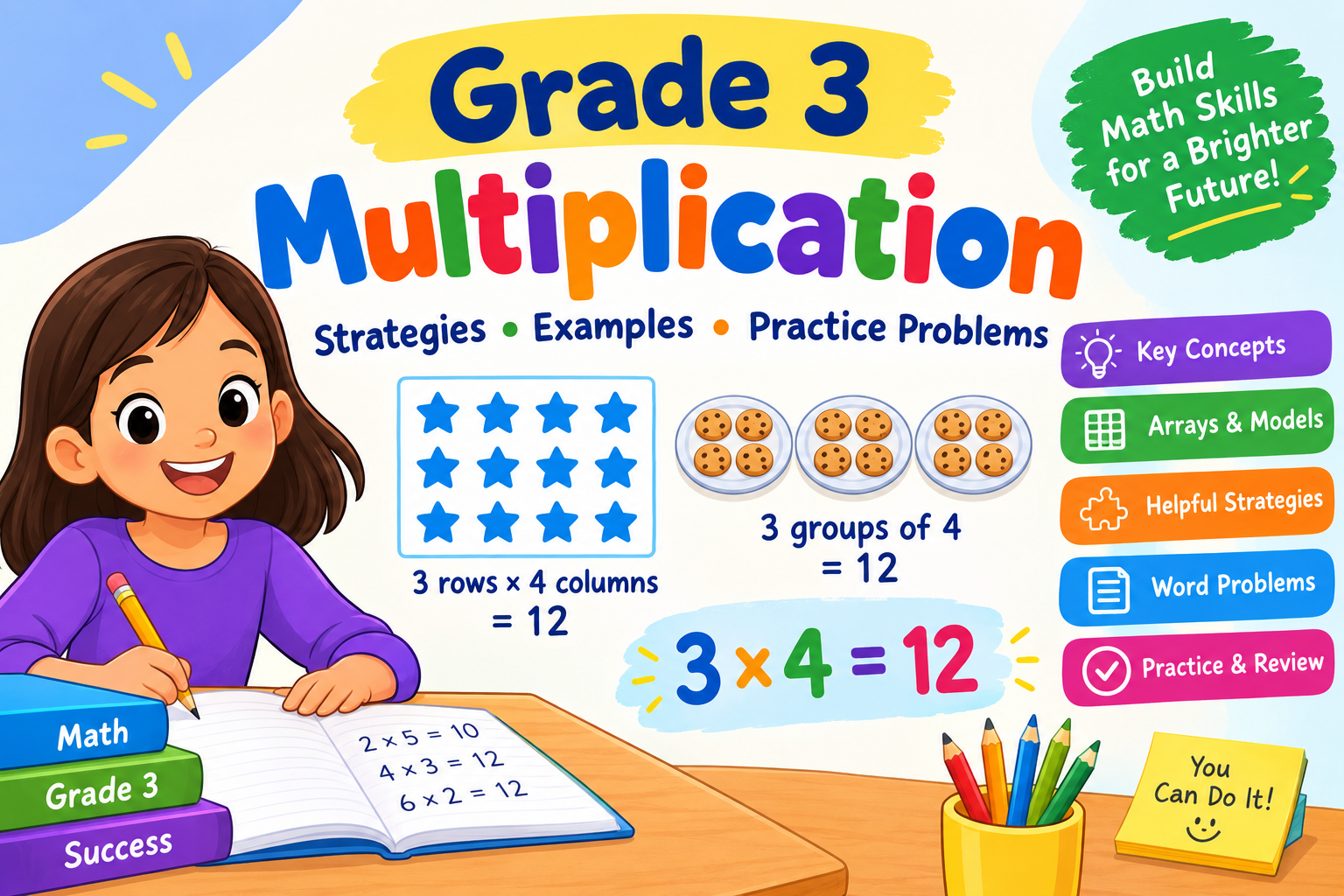
Multiplication is an important math skill that Grade 3 students use every day. It helps students work with equal groups, arrays, repeated addition, and real-world problems.
In this guide, you’ll learn what multiplication means, how to use arrays, important multiplication properties, easy strategies, multiplication facts, word problems, and practice questions.
What Is Multiplication?
Multiplication is a way to find the total in equal groups. It can also be understood as repeated addition.
For example, if you have 3 plates and each plate has 4 cookies, you have 3 equal groups of 4 cookies.
- Repeated addition: 4 + 4 + 4 = 12
- Multiplication: 3 × 4 = 12
So, 3 × 4 means 3 groups of 4, and the product is 12.
Understanding Multiplication Symbols
- Factors: The numbers being multiplied. In 3 × 4, the factors are 3 and 4.
- Product: The answer to a multiplication problem. In 3 × 4 = 12, the product is 12.
- Multiplication symbol (×): This symbol tells us to multiply.
For example: 3 × 4 = 12. You can read this as “3 groups of 4 equal 12.”
Multiplication Using Arrays
An array is a group of objects arranged in equal rows and columns. Arrays help students visualize multiplication.
Look at this array:
★ ★ ★ ★
★ ★ ★ ★
★ ★ ★ ★
There are 3 rows with 4 stars in each row.
3 × 4 = 12
There are 12 stars altogether.
Turning an Array Around
Now turn the array:
★ ★ ★
★ ★ ★
★ ★ ★
★ ★ ★
This array has 4 rows with 3 stars in each row.
4 × 3 = 12
The total is still 12. This demonstrates the Commutative Property of Multiplication: changing the order of the factors does not change the product.
3 × 4 = 4 × 3 = 12
Important Multiplication Properties
1. Commutative Property
The Commutative Property means that changing the order of the factors does not change the product.
For example: 3 × 5 = 15 and 5 × 3 = 15.
Think of it as the Switch Rule: you can switch the factors, and the answer stays the same.
2. Identity Property
The Identity Property of Multiplication says that multiplying any number by 1 gives you the same number.
- 7 × 1 = 7
- 1 × 25 = 25
- 42 × 1 = 42
Think of 1 as a Mirror Rule: the number stays the same.
3. Zero Property
The Zero Property of Multiplication says that any number multiplied by 0 equals 0.
- 9 × 0 = 0
- 0 × 100 = 0
- 25 × 0 = 0
No matter how large the other factor is, multiplying by zero gives a product of zero.
Easy Multiplication Strategies for Grade 3
Skip Counting
Skip counting means counting by the same number repeatedly.
For example, to solve 5 × 3, you can count by 5s three times: 5, 10, 15. So, 5 × 3 = 15.
Doubling: The 2s Facts
Multiplying by 2 is the same as doubling a number.
2 × 6 = 6 + 6 = 12
Multiplying by 5
You can use skip counting to solve multiplication facts with 5. For example, 5 × 4 = 20. Count by 5s four times: 5, 10, 15, 20.
Multiplying by 10
When multiplying a whole number by 10, the product is 10 times the number. For example, 10 × 7 = 70.
Another way to think about this with whole numbers is that the 7 becomes 7 tens, which is 70.
Breaking Apart Numbers
You can break a factor into smaller numbers to make a difficult multiplication problem easier.
For example: 7 × 6. Break 7 into 5 + 2:
- 5 × 6 = 30
- 2 × 6 = 12
- 30 + 12 = 42
Therefore: 7 × 6 = 42
Multiplication Facts for Grade 3
This table shows some useful multiplication facts involving 0, 1, 2, 5, and 10.
| Factor | × 0 | × 1 | × 2 | × 5 | × 10 |
| 1 | 0 | 1 | 2 | 5 | 10 |
| 2 | 0 | 2 | 4 | 10 | 20 |
| 3 | 0 | 3 | 6 | 15 | 30 |
| 4 | 0 | 4 | 8 | 20 | 40 |
| 5 | 0 | 5 | 10 | 25 | 50 |
| 6 | 0 | 6 | 12 | 30 | 60 |
| 7 | 0 | 7 | 14 | 35 | 70 |
| 8 | 0 | 8 | 16 | 40 | 80 |
| 9 | 0 | 9 | 18 | 45 | 90 |
| 10 | 0 | 10 | 20 | 50 | 100 |
Learning the patterns in this table can make multiplication facts easier to remember.
Step-by-Step Multiplication Examples
Example 1: 2 × 6
Think of 2 groups of 6: 6 + 6 = 12. So: 2 × 6 = 12
Example 2: 3 × 7
Think of 3 groups of 7: 7 + 7 + 7 = 21. So: 3 × 7 = 21
Example 3: 4 × 8
Use doubling: Double 8 → 16. Double 16 → 32. So: 4 × 8 = 32
Example 4: 5 × 9
Count by 5s nine times: 5, 10, 15, 20, 25, 30, 35, 40, 45. So: 5 × 9 = 45
Example 5: 6 × 6
Think of 6 groups of 6: 6 + 6 + 6 + 6 + 6 + 6 = 36. So: 6 × 6 = 36
Example 6: 7 × 8
A helpful fact to remember is: 7 × 8 = 56
Example 7: 9 × 4
10 × 4 = 40. Then subtract one group of 4: 40 − 4 = 36. So: 9 × 4 = 36
Example 8: 10 × 7
Multiplying 7 by 10 gives: 10 × 7 = 70
Example 9: 8 × 7
Break 8 into 4 + 4: 4 × 7 = 28; 4 × 7 = 28; 28 + 28 = 56. Therefore: 8 × 7 = 56
Example 10: 3 × 12
Break 12 into 10 + 2: 3 × 10 = 30; 3 × 2 = 6; 30 + 6 = 36. Therefore: 3 × 12 = 36
Multiplication Word Problems
1. The Pencil Case
Maya bought 4 packs of pencils. Each pack has 8 pencils. How many pencils does she have?
Equation: 4 × 8 = 32
Answer: 32 pencils
2. The Pet Store
A pet store has 5 fish tanks. Each tank has 9 goldfish. How many goldfish are there in total?
Equation: 5 × 9 = 45
Answer: 45 goldfish
3. The Bakery
A baker puts 6 rows of cupcakes on a tray. Each row has 4 cupcakes. How many cupcakes are on the tray?
Equation: 6 × 4 = 24
Answer: 24 cupcakes
4. Soccer Practice
There are 3 soccer teams. Each team has 10 players. How many players are there altogether?
Equation: 3 × 10 = 30
Answer: 30 players
5. Fruit Baskets
A basket holds 7 apples. How many apples are in 0 baskets?
Equation: 7 × 0 = 0
Answer: 0 apples
Grade 3 Multiplication Practice
Test your multiplication skills with these 30 Grade 3 multiplication problems.
- 2 × 5 = _____
- 3 × 3 = _____
- 10 × 4 = _____
- 5 × 6 = _____
- 1 × 9 = _____
- 0 × 8 = _____
- 4 × 4 = _____
- 7 × 2 = _____
- 9 × 2 = _____
- 5 × 5 = _____
- 3 × _____ = 12
- _____ × 5 = 20
- 6 × _____ = 18
- _____ × 10 = 90
- 2 × _____ = 16
- 4 × 3 is the same as 3 × 4. True or False?
- 5 × 0 = 5. True or False?
- 7 × 1 = 7. True or False?
- 2 × 8 = 18. True or False?
- Which equation represents 3 groups of 6? A. 3 + 6 B. 3 × 6 C. 6 − 3
- What is the product of 4 and 5? A. 9 B. 15 C. 20
- Which description represents an array for 2 × 3? A. 2 rows of 3 B. 3 rows of 3 C. 2 rows of 2
- A spider has 8 legs. How many legs do 3 spiders have?
- There are 5 boxes of crayons. Each box has 10 crayons. How many crayons are there in total?
- If 5 × 4 = 20, what is 5 × 5? Hint: Add one more group of 5.
- Find the missing factor: 7 × _____ = 21
- A classroom has 4 rows of desks with 6 desks in each row. How many desks are there?
- True or False: 9 × 3 = 27
- Challenge: What is (2 × 3) × 2?
- Challenge: You have 2 bags with 5 apples in each bag. Your friend gives you another bag with 5 apples. How many apples do you have altogether?
Answer Key
- 10
- 9
- 40
- 30
- 9
- 0
- 16
- 14
- 18
- 25
- 4
- 4
- 3
- 9
- 8
- True — Commutative Property
- False — Any number multiplied by 0 equals 0.
- True — Identity Property
- False — 2 × 8 = 16
- B. 3 × 6
- C. 20
- A. 2 rows of 3
- 24 legs — 3 × 8 = 24
- 50 crayons — 5 × 10 = 50
- 25 — 5 × 5 = 25
- 3 — 7 × 3 = 21
- 24 desks — 4 × 6 = 24
- True — 9 × 3 = 27
- 12 — First, 2 × 3 = 6. Then, 6 × 2 = 12.
- 15 apples — 3 × 5 = 15
Common Multiplication Mistakes
1. Adding Instead of Multiplying
A student might think 3 × 2 = 5. But 3 × 2 means 3 groups of 2: 2 + 2 + 2 = 6. So, 3 × 2 = 6.
2. Forgetting the Zero Property
A student might think 5 × 0 = 5. The correct answer is 5 × 0 = 0. Remember: any number multiplied by zero has a product of zero.
3. Forgetting the Identity Property
A student might think 7 × 1 = 1. The correct answer is 7 × 1 = 7. Multiplying a number by 1 keeps the number unchanged.
4. Making Skip-Counting Errors
A student may count 5, 10, 20 and accidentally skip 15. Practice counting by 2s, 5s, and 10s to build accuracy.
5. Misreading an Array
When looking at an array, students may confuse rows and columns. Count the rows first and then count the number of objects in each row. An array with 3 rows and 4 objects in each row represents 3 × 4 = 12.
Quick Multiplication Review
- Multiplication helps us find the total in equal groups.
- Multiplication can also be represented as repeated addition.
- The numbers being multiplied are called factors.
- The answer to a multiplication problem is called the product.
- Arrays use rows and columns to show multiplication.
- The Commutative Property means the order of factors does not change the product.
- Multiplying any number by 0 gives 0.
- Multiplying any number by 1 gives the same number.
- Skip counting can help with multiplication facts.
- Breaking a factor into smaller parts can make difficult multiplication problems easier.
Mini Multiplication Quiz
- 5 × 3 = _____
- 2 × 9 = _____
- 10 × 6 = _____
- 0 × 12 = _____
- What is 3 groups of 4?
- Fill in the blank: 4 × _____ = 16.
- Which is greater: 2 × 5 or 3 × 3?
- An array has 5 rows and 2 columns. How many objects are there?
- A baker makes 4 boxes of donuts. Each box has 6 donuts. How many donuts are there?
- Challenge: 2 × 2 × 2 = _____
Quiz Answers
- 15
- 18
- 60
- 0
- 12
- 4
- 2 × 5 — 10 is greater than 9.
- 10
- 24
- 8
Frequently Asked Questions About Grade 3 Multiplication
What is multiplication for Grade 3?
In Grade 3, multiplication helps students find the total in equal groups. Students learn to represent multiplication using groups, arrays, repeated addition, equations, and real-world situations. Multiplication is also an important foundation for learning division, area, fractions, and more advanced math.
What multiplication facts should a 3rd grader know?
By the end of Grade 3, students are generally expected to develop fluency with multiplication facts within 100. Students often begin by mastering easier patterns such as the 0s, 1s, 2s, 5s, and 10s before working toward other multiplication facts.
How can I help my child learn multiplication?
Make multiplication part of everyday activities. Count objects in groups, use LEGO bricks to create arrays, count socks by 2s, or practice multiplication facts with cards and simple games. Short, regular practice sessions can be more effective than trying to memorize many facts at once.
What is the easiest way to learn multiplication facts?
Start with patterns that are easy to recognize: 0s always equal 0; 1s keep the number the same; 2s are doubles; 5s follow a predictable counting pattern; and 10s create groups of ten. Once these facts are familiar, students can use doubling, skip counting, and breaking apart factors to solve more difficult facts.
How do you solve multiplication word problems?
First, identify the equal groups in the problem. Look for how many groups there are, how many objects are in each group, and what total the problem is asking you to find. Words such as each, every, groups of, and total can provide useful clues, but students should focus on the meaning of the problem rather than relying only on keywords. Drawing a picture or array can also help.
What is the relationship between multiplication and division?
Multiplication and division are inverse operations. For example, 3 × 4 = 12. The related division facts are 12 ÷ 4 = 3 and 12 ÷ 3 = 4. These equations belong to the same fact family.
Final Takeaway
Multiplication becomes easier when students understand what the numbers mean instead of only memorizing facts.
Start with equal groups and arrays, practice the 0, 1, 2, 5, and 10 facts, and use strategies such as skip counting, doubling, and breaking apart factors.
With regular practice, Grade 3 students can build the multiplication skills they need for more advanced math.