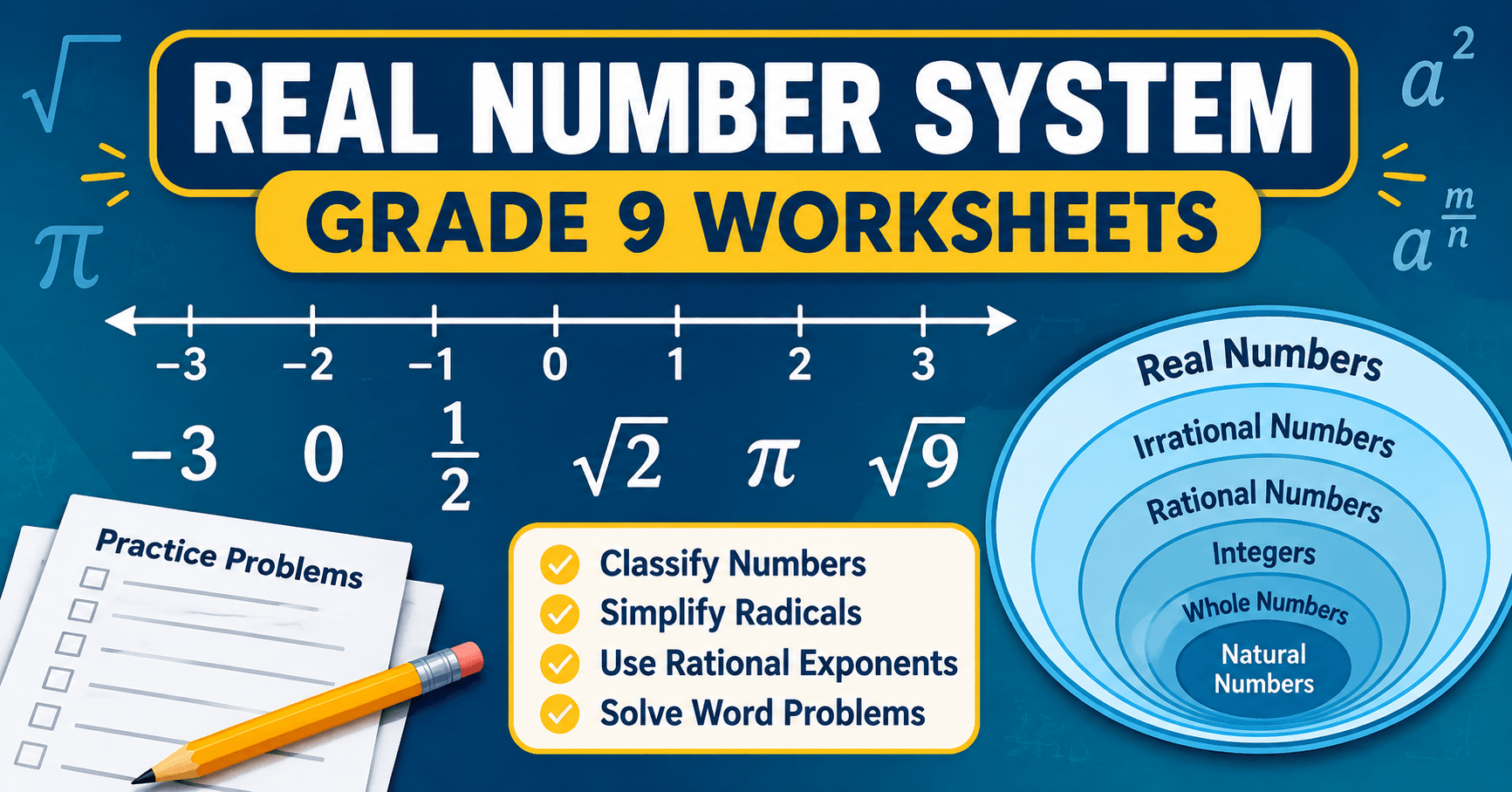
Real Number System Worksheets for Grade 9: Printable Practice with Answer Keys
Real number system worksheets help Grade 9 students sort, compare, and calculate with every point on the number line. This printable set moves from simple classification to radicals, rational exponents, and multi-step word problems. Each of the eight sections contains 30 questions for steady, focused practice. Finally, the answer keys sit at the end of the page for quick checking.
Download Real Number System Worksheets Pdf
Students begin these real number system worksheets by reviewing natural numbers, whole numbers, integers, and rational numbers. Next, they meet irrational numbers such as π and √2 on the number line. They simplify radicals, convert repeating decimals to fractions, and rewrite rational exponents. As a result, the page works for classroom lessons, tutoring sessions, and independent review at home.
How to Use These Worksheets
Print the pages, or work on a tablet with a notebook nearby. First, write your name and date on the line at the top of the practice section. Complete the Easy set, and save the Medium and Advanced sets for later sessions. Because each level builds on the last, a steady pace works better than skipping ahead.
Teachers can assign one section per day with these real number system worksheets. Parents and tutors can use the Mixed sets as weekly reviews instead. The answer keys appear at the end of the page, which lets students complete each problem and review their work. Afterward, mark each missed problem and revisit the related skill.
Skills Covered
The real number system worksheets target six core skills. Each skill returns in several sections at a higher level of difficulty.
- Classify numbers as natural, whole, integer, rational, or irrational.
- Write terminating and repeating decimals as fractions in simplest form.
- Estimate and compare the sizes of square roots and cube roots.
- Simplify radical expressions and rationalize denominators in fractions.
- Evaluate expressions with rational exponents and radical notation.
- Explain why sums and products of rational and irrational numbers behave as they do.
Relevant Common Core Standards
The main standards for this topic come from the high school Number and Quantity domain. Specifically, these real number system worksheets connect to three codes listed on the official Common Core HSN-RN page.
- HSN-RN.A.1: Explain how rational exponents follow from extending the properties of integer exponents.
- HSN-RN.A.2: Rewrite expressions with radicals and rational exponents using the properties of exponents.
- HSN-RN.B.3: Explain why sums and products of rational numbers are rational. Explain why a rational plus an irrational is irrational, and a nonzero rational times an irrational is irrational.
Grade 8 review standards support the ideas in this topic. In particular, 8.NS.A.1 covers irrational numbers and repeating decimals, while 8.NS.A.2 covers rational approximations. Teachers can read both on the Grade 8 Number System standards page. Meanwhile, standard 8.EE.A.2 supports work with square roots and cube roots. Rational exponents may extend beyond Algebra 1 in some districts, so treat those questions as enrichment.
Real Number System Worksheets: Printable Practice and Word Problems
Choose the level that fits your learner, or work through all eight sets in order. These real number system worksheets alternate between skill practice and word problems.
Name: ______________________________ Date: ____________________
Easy Practice Problems: Classify and Convert
Directions: Solve each problem. Show your work in the space provided.
Questions 1–10
Q1. Is √25 rational or irrational?
Q2. Decide whether √7 is rational or irrational.
Q3. Label 0.75 as rational or irrational.
Q4. Tell whether π is rational or irrational.
Q5. Classify −12 as rational or irrational.
Q6. State whether 3/8 is rational or irrational.
Q7. Is √64 rational or irrational?
Q8. Decide whether √11 is rational or irrational.
Q9. Label 0.333… (the 3 repeats forever) as rational or irrational.
Q10. Tell whether √20 is rational or irrational.
Questions 11–20
Q11. Is 0 a whole number? Answer yes or no.
Q12. Does the set of whole numbers include −4? Answer yes or no.
Q13. Answer yes or no: Is −4 an integer?
Q14. True or false: Every integer is a rational number.
Q15. Decide whether this statement is true or false: Every irrational number is a real number.
Q16. Mark this statement true or false: 0.5 is an integer.
Q17. True or false: π equals exactly 3.14.
Q18. Express 6 as a fraction of two integers.
Q19. Write 0.5 as a fraction in simplest form.
Q20. Convert 0.2 to a fraction in simplest form.
Questions 21–30
Q21. Express 0.25 as a fraction in simplest form.
Q22. Find √81.
Q23. What is √100?
Q24. Calculate √144.
Q25. Find ∛27.
Q26. What is ∛64?
Q27. Which is greater: √9 or 2.5?
Q28. Of 1.5 and √2, which number is greater?
Q29. Between which two consecutive whole numbers does √10 lie?
Q30. √17 lies between which two consecutive whole numbers?
Medium Practice Problems: Radicals and Decimals
Directions: Answer each question. Write fractions in simplest form.
Questions 1–10
Q1. Is √(49/4) rational or irrational?
Q2. Decide whether √0.16 is rational or irrational.
Q3. Label 0.121212… (the 12 repeats forever) as rational or irrational.
Q4. Tell whether 5π is rational or irrational.
Q5. Classify 0.1010010001… (each new group adds one more zero) as rational or irrational.
Q6. State whether −√81 is rational or irrational.
Q7. Is (√8)(√2) rational or irrational?
Q8. Decide whether 4 + √3 is rational or irrational.
Q9. Label 22/7 as rational or irrational.
Q10. Tell whether ∛(−8) is rational or irrational.
Questions 11–20
Q11. Write 0.777… as a fraction.
Q12. Convert 0.454545… to a fraction in simplest form.
Q13. Express 0.555… as a fraction.
Q14. Rewrite 0.636363… as a fraction in simplest form.
Q15. Write 0.125 as a fraction in simplest form.
Q16. Rewrite 3/8 as a decimal.
Q17. Write 7/20 as a decimal.
Q18. Convert 4/9 to a decimal.
Q19. Simplify √50.
Q20. Write √72 in simplest form.
Questions 21–30
Q21. Find the simplified form of √48.
Q22. Simplify √45.
Q23. Estimate √30 to the nearest tenth.
Q24. Approximate √87 to the nearest tenth.
Q25. Give an estimate of ∛20 to the nearest tenth.
Q26. Order from least to greatest: √5, 2, 2.3, 9/4.
Q27. Compare using <, >, or =: √20 ___ 4.5.
Q28. Insert <, >, or = to make the statement true: −√3 ___ −1.7.
Q29. Between which two tenths does √7 lie?
Q30. Classify 3/4 + 0.2 as rational or irrational.
Advanced Practice Problems: Exponents and Operations
Directions: Simplify or classify each expression.
Questions 1–10
Q1. Evaluate 16^(1/2).
Q2. Find the value of 27^(1/3).
Q3. Compute 8^(2/3).
Q4. Calculate 25^(3/2).
Q5. Evaluate 16^(3/4).
Q6. Find the value of 32^(2/5).
Q7. Compute 4^(−1/2).
Q8. Calculate 81^(−3/4).
Q9. Evaluate 125^(−2/3).
Q10. Write the fourth root of x^3 using a rational exponent.
Questions 11–20
Q11. Express x^(5/2) as a radical expression. Assume x ≥ 0.
Q12. Simplify (√5)(√20).
Q13. Write (√6)(√24) in simplest form.
Q14. Find the simplified form of √12 + √27.
Q15. Simplify 3√2 + 5√2.
Q16. Write √75 − √12 in simplest form.
Q17. Find the simplified form of (3 + √2)(3 − √2).
Q18. Simplify (√7 + 2)^2.
Q19. Rationalize the denominator: 6/√3.
Q20. Write 10/√5 with a rational denominator.
Questions 21–30
Q21. Remove the radical from the denominator of 1/(√3 + 1).
Q22. Is (√3)(√12) rational or irrational?
Q23. Decide whether 1/3 + √2 is rational or irrational.
Q24. Label the product of 5 and π as rational or irrational.
Q25. Tell whether the product of 0 and √2 is rational or irrational.
Q26. Classify the sum √2 + (−√2) as rational or irrational.
Q27. State whether (2 + √5) + (2 − √5) is rational or irrational.
Q28. √8 times what number equals 4?
Q29. True or false: The sum of two irrational numbers is always irrational.
Q30. Decide whether this statement is true or false: The product of two rational numbers is always rational.
Mixed Practice Problems: All Skills
Directions: Solve each problem. Skills change from question to question.
Questions 1–10
Q1. Is √121 rational or irrational?
Q2. Decide whether 6√3 is rational or irrational.
Q3. Label 0.0625 as rational or irrational.
Q4. Tell whether −√(1/9) is rational or irrational.
Q5. Classify √2 + √2 as rational or irrational.
Q6. Evaluate ∛125.
Q7. Find the value of 49^(1/2).
Q8. Compute 64^(2/3).
Q9. Simplify √98.
Q10. Write √200 in simplest form.
Questions 11–20
Q11. Find the simplified form of (2√3)(4√3).
Q12. Write 0.181818… as a fraction in simplest form.
Q13. Convert 0.6 to a fraction in simplest form.
Q14. Write 11/25 as a decimal.
Q15. Estimate √55 to the nearest tenth.
Q16. Between which two consecutive integers does ∛30 lie?
Q17. Order from least to greatest: π, 3.1, √10, 22/7.
Q18. Compare using <, >, or =: √50 ___ 7.
Q19. Insert <, >, or = to make the statement true: −√10 ___ −3.2.
Q20. Simplify (√10)(√40).
Questions 21–30
Q21. Write 4√5 − √20 in simplest form.
Q22. Find the simplified form of (4 + √3)(4 − √3).
Q23. Rationalize the denominator: 12/√6.
Q24. State whether 3/5 + √7 is rational or irrational.
Q25. Is the product of 1/4 and √13 rational or irrational?
Q26. Decide whether (√5)(√5) is rational or irrational.
Q27. True or false: √16 + √9 = √25.
Q28. Decide whether this statement is true or false: Every real number is either rational or irrational, but never both.
Q29. Which is the smallest set that contains −7: natural numbers, whole numbers, or integers?
Q30. Is √(−9) a real number? Answer yes or no.
Download Real Number System Worksheets Pdf
Easy Word Problems: Everyday Numbers
Directions: Read each problem. Write your answer with the correct unit.
Questions 1–10
Q1. A square garden covers 49 square feet. How long is one side, in feet?
Q2. Ben cuts a square tile with an area of 81 square inches. Find its side length.
Q3. A square patio has an area of 121 square feet. What is the length of each side?
Q4. The area of a square picture frame is 36 square inches. How long is one side?
Q5. A square playground has an area of 100 square meters. Find the length of one side.
Q6. Maria buys a square rug that covers 144 square feet. How wide is the rug?
Q7. A square stage floor measures 169 square feet. What is the length of one edge?
Q8. Dylan paints a square window frame with an area of 64 square inches. Find one side length.
Q9. A cube-shaped box holds 27 cubic inches. How long is each edge, in inches?
Q10. An ice cube has a volume of 8 cubic centimeters. Find its edge length.
Questions 11–20
Q11. A cubic crate has a volume of 125 cubic feet. How tall is the crate?
Q12. A toy block is a cube with a volume of 216 cubic inches. Find the length of one edge.
Q13. A pitcher holds 3/4 gallon of lemonade. Write this amount as a decimal.
Q14. Luis walks 3/5 mile to school. Write the distance as a decimal.
Q15. A bag of flour weighs 7/8 pound. How much is that, written as a decimal?
Q16. Nine-twentieths of the class plays soccer. Write that part as a decimal.
Q17. Piano practice lasts 0.5 hour. Write this time as a fraction in simplest form.
Q18. Grace eats 0.2 of a pizza. Write this amount as a fraction.
Q19. Exactly 0.4 of the students ride the bus. Write that part as a fraction in simplest form.
Q20. At dawn, the temperature is −8°F. It rises 15 degrees by noon. What is the noon temperature?
Questions 21–30
Q21. A diver floats at −20 feet and swims up 6 feet. What is the new depth?
Q22. Mia measures a ribbon at 3.5 meters. Is 3.5 rational or irrational?
Q23. A calculator shows √2 as 1.41421356… with no end or pattern. Is √2 rational or irrational?
Q24. Dad buys 3 1/2 pounds of apples. Is 3 1/2 an integer? Answer yes or no.
Q25. The home team scored 0 points. Is 0 a whole number? Answer yes or no.
Q26. A square mat has an area of 50 square feet. Is its side length a whole number? Answer yes or no.
Q27. Tara has a square tile with an area of 20 square inches. Between which two whole numbers is its side length?
Q28. The area of a square mousepad is 30 square inches. Its side lies between which two whole numbers?
Q29. Board A is 2.5 feet long. Board B is √9 feet long. Which board is longer?
Q30. Carlos says 0.25 is irrational because it is a decimal. Is he correct? Answer yes or no.
Medium Word Problems: Measurement and Estimation
Directions: Read each problem. Round only when the problem asks you to.
Questions 1–10
Q1. A square plot has an area of 75 square feet. Find its side length in simplest radical form.
Q2. The area of a square deck is 200 square feet. Write one side length in simplest radical form.
Q3. A square garden bed covers 45 square feet. Give its side length in simplest radical form.
Q4. The area of a square banner is 32 square meters. Find one side in simplest radical form.
Q5. Each square tile has an area of 98 square centimeters. Write its side length in simplest radical form.
Q6. A square sandbox has an area of 28 square feet. What is each side length in simplest radical form?
Q7. A right triangle has legs of 6 inches and 8 inches. How long is the hypotenuse?
Q8. A ramp rises 5 feet over a ground distance of 12 feet. Find the ramp length.
Q9. A square garden has 4-foot sides. Find the diagonal path in simplest radical form.
Q10. A right triangle has legs of 3 feet and 6 feet. Find the hypotenuse in simplest radical form.
Questions 11–20
Q11. A wheelchair ramp has legs of 2 meters and 5 meters. Estimate its length to the nearest tenth.
Q12. A 12-foot wall stands above a ladder base that is 5 feet away. How long is the ladder?
Q13. A TV screen is 16 inches wide and 12 inches tall. Find the diagonal length.
Q14. A square deck has 10-foot sides. Estimate its diagonal to the nearest tenth of a foot.
Q15. A circular rug has a radius of 5 feet. What is its exact circumference in terms of π?
Q16. A pie has a diameter of 9 inches. Give its exact circumference in terms of π.
Q17. A circle has a radius of 4 centimeters. Is its circumference exactly 25.12 centimeters? Answer yes or no.
Q18. A circular garden has a radius of 6 feet. Find its exact area in terms of π.
Q19. A gauge reads 0.363636… gallons. Write this amount as a fraction in simplest form.
Q20. A timer shows 0.272727… hours. Write the time as a fraction in simplest form.
Questions 21–30
Q21. A player’s success rate is 0.666…. Write this rate as a fraction.
Q22. A leaky pipe loses 0.151515… liters each minute. Write that amount as a fraction in simplest form.
Q23. Ana studies for 2.4 hours. Write this time as a mixed number in simplest form.
Q24. Three boards measure √20 feet, 4.4 feet, and 9/2 feet. Which board is the shortest?
Q25. Three ropes measure √26 feet, 5.2 feet, and 21/4 feet. Which rope is the longest?
Q26. A square courtyard has an area of 150 square meters. Estimate one side to the nearest tenth.
Q27. A cube-shaped tank holds 100 cubic feet. Estimate its edge length to the nearest tenth of a foot.
Q28. A square lot covers 90 square yards. Its side length lies between which two consecutive integers?
Q29. One trail is 2.5 miles long. Another is √3 miles long. Is the total distance rational or irrational?
Q30. A mat is 3/4 foot wide and √5 feet long. Is its area rational or irrational?
Advanced Word Problems: Multi-Step Reasoning
Directions: Read each problem. Write exact answers unless told to estimate.
Questions 1–10
Q1. A 17-foot ladder leans on a wall with its base 8 feet away. How high does it reach?
Q2. A phone screen is 24 millimeters wide and 7 millimeters tall. Find its diagonal.
Q3. A hiker walks 9 miles east, then 12 miles north. How far is she from the start in a straight line?
Q4. On a map grid, a trail runs from (1, 2) to (7, 10). Find the trail length in units.
Q5. A drone flies from (−3, 4) to (2, 16) on a grid. How many units does it travel?
Q6. A bug crawls from (0, 0) to (6, 6) on graph paper. Find the exact distance in units.
Q7. The diagonal of a square window is 14 inches. Find the exact side length.
Q8. A square tile has 8-foot sides. Find the exact length of its diagonal.
Q9. A circular pond has an area of 49π square meters. What is its radius?
Q10. Kai cuts a circular mat with an area of 50π square inches. Find its exact radius.
Questions 11–20
Q11. A cube has a surface area of 150 square inches. Find its edge length.
Q12. The surface area of a cube is 96 square centimeters. How long is one edge?
Q13. A cube-shaped safe has a volume of 343 cubic inches. Find its edge length.
Q14. A formula gives a square’s side as s = A^(1/2). Find s when A = 196 square feet.
Q15. A planet’s orbit follows T = r^(3/2). Find T when r = 16.
Q16. Using T = r^(3/2), find T for a moon with r = 9.
Q17. A cube’s edge is L = V^(1/3). Find L when the volume V is 512 cubic centimeters.
Q18. A string’s frequency is f = 1/√L. Find f when L = 16.
Q19. A pendulum’s period is T = 2π√(L/32). Find T, in seconds, when L = 8.
Q20. Using T = 2π√(L/32), find the period, in seconds, when L = 2.
Questions 21–30
Q21. A square has an area of 18 square units. Is its perimeter rational or irrational?
Q22. A circle has a radius of 3 inches. Is its area, 9π square inches, rational or irrational?
Q23. A rectangle is 2 feet wide and (3 + √2) feet long. Is its perimeter rational or irrational?
Q24. The sides of a rectangle measure √6 and √24 inches. Find its area.
Q25. Rosa builds a rectangle with sides of √18 and √8 feet. Find its perimeter in simplest radical form.
Q26. A triangle has a base of √12 centimeters and a height of √3 centimeters. Find its area.
Q27. A rope is 15/√5 feet long. Write its length with a rational denominator.
Q28. A sign is (5 + √2) feet wide and (5 − √2) feet tall. Find its area.
Q29. A square rug has side length (2 + √3) feet. Find its exact area.
Q30. A right triangle has legs of √7 meters and 3 meters. Find the hypotenuse.
Mixed Word Problems: Real-World Review
Directions: Read each problem. Choose a strategy, then solve.
Questions 1–10
Q1. A square quilt covers 225 square feet. How long is each side?
Q2. The area of a square lot is 256 square yards. Find one side length.
Q3. A cube of cheese has a volume of 1,000 cubic centimeters. Find its edge length.
Q4. A storage cube holds 729 cubic feet. How long is each edge?
Q5. Eli runs 5/16 mile on Monday. Write that distance as a decimal.
Q6. A recipe needs 11/20 cup of milk. Write the amount as a decimal.
Q7. Julia’s ribbon is 13/40 meter long. Write its length as a decimal.
Q8. Exactly 0.28 of the library books are mysteries. Write that part as a fraction in simplest form.
Q9. A battery has 0.12 of its charge left. Write that part as a fraction in simplest form.
Q10. A bottle holds 0.444… liter of juice. Write this amount as a fraction.
Questions 11–20
Q11. A scale reads 0.090909… pounds. Write that weight as a fraction.
Q12. A kite string forms a right triangle with legs of 9 feet and 40 feet. Find the hypotenuse.
Q13. A ramp has legs of 20 inches and 21 inches. How long is the ramp?
Q14. A right triangle has two 7-inch legs. Find the hypotenuse in simplest radical form.
Q15. A bike path has legs of 2 miles and 3 miles. Estimate the shortcut to the nearest tenth.
Q16. A square patio has 6-foot sides. Find the exact length of its diagonal.
Q17. Sam paints a square mural with an area of 60 square feet. Estimate one side to the nearest tenth.
Q18. The square pool cover has an area of 70 square feet. Its side lies between which two integers?
Q19. A path is √45 feet long. Is it longer or shorter than 6.5 feet?
Q20. Which is greater: a √8-inch strip or a 2.8-inch strip?
Questions 21–30
Q21. Lengths of 3.2 feet, √10 feet, and 13/4 feet are cut. List them from shortest to longest.
Q22. A circular table has a diameter of 14 inches. Give its exact circumference in terms of π.
Q23. A round garden has a radius of 8 feet. Find its exact area in terms of π.
Q24. A tile’s side is √49 inches long. Is that length rational or irrational?
Q25. A square has an area of 12 square feet. Is its perimeter rational or irrational?
Q26. Tina rides 1.5 miles, then runs π miles. Is her total distance rational or irrational?
Q27. A rectangle is 4 feet wide and π feet long. Is its perimeter rational or irrational?
Q28. A satellite follows T = r^(3/2). Find T when r = 4.
Q29. A square’s side is s = A^(1/2). Find s when A = 289 square meters.
Q30. A rectangle has sides of √10 and √40 feet. Find its area.
Download Real Number System Worksheets Pdf
Real Number System Worksheets: Frequently Asked Questions
What grade level fits these worksheets?
These pages suit Grade 9 students, including those in a first-year Algebra 1 course. However, Grade 8 learners can try the Easy and Medium sets after studying irrational numbers. Advanced classes may treat the exponent questions as enrichment practice. For earlier skills, see [INTERNAL LINK: Grade 8 square roots and cube roots worksheets – related worksheet URL to be added].
What topics do the worksheets cover?
The real number system worksheets cover classification, decimal conversion, radicals, and rational exponents. In addition, the word problems apply those ideas to area, volume, distance, and measurement. Students practice both procedural skills and mathematical reasoning.
How can I tell if a number is irrational?
A number is irrational if it cannot be written as a fraction of two integers. For example, √2 and π have decimals that never end or repeat. In contrast, decimals such as 0.25 and roots such as √49 are rational. For extra practice, try this Khan Academy exercise on classifying rational and irrational numbers.
Are answer keys included?
Yes, every question has an answer in the final section. As a result, students can check their work after finishing each set. The tables place three question-and-answer pairs in each row to save space.
Build Confidence with Real Numbers Practice
Strong number sense makes algebra, geometry, and science much easier to learn. With regular practice, students learn to classify numbers, simplify radicals, and explain how sums and products behave. Print the sets you need, work at a steady pace, and check every answer at the end.
Real Number System Worksheets: Answer Keys
Check your work with these real number system worksheets answer keys. Each table matches one worksheet section, and the question numbers stay identical to the worksheet.
Easy Practice Problems: Classify and Convert
| Q# | Answer | Q# | Answer | Q# | Answer |
| 1 | Rational | 2 | Irrational | 3 | Rational |
| 4 | Irrational | 5 | Rational | 6 | Rational |
| 7 | Rational | 8 | Irrational | 9 | Rational |
| 10 | Irrational | 11 | Yes | 12 | No |
| 13 | Yes | 14 | True | 15 | True |
| 16 | False | 17 | False | 18 | 6/1 |
| 19 | 1/2 | 20 | 1/5 | 21 | 1/4 |
| 22 | 9 | 23 | 10 | 24 | 12 |
| 25 | 3 | 26 | 4 | 27 | √9 |
| 28 | 1.5 | 29 | 3 and 4 | 30 | 4 and 5 |
Medium Practice Problems: Radicals and Decimals
| Q# | Answer | Q# | Answer | Q# | Answer |
| 1 | Rational | 2 | Rational | 3 | Rational |
| 4 | Irrational | 5 | Irrational | 6 | Rational |
| 7 | Rational | 8 | Irrational | 9 | Rational |
| 10 | Rational | 11 | 7/9 | 12 | 5/11 |
| 13 | 5/9 | 14 | 7/11 | 15 | 1/8 |
| 16 | 0.375 | 17 | 0.35 | 18 | 0.444… |
| 19 | 5√2 | 20 | 6√2 | 21 | 4√3 |
| 22 | 3√5 | 23 | 5.5 | 24 | 9.3 |
| 25 | 2.7 | 26 | 2, √5, 9/4, 2.3 | 27 | < |
| 28 | < | 29 | 2.6 and 2.7 | 30 | Rational |
Advanced Practice Problems: Exponents and Operations
| Q# | Answer | Q# | Answer | Q# | Answer |
| 1 | 4 | 2 | 3 | 3 | 4 |
| 4 | 125 | 5 | 8 | 6 | 4 |
| 7 | 1/2 | 8 | 1/27 | 9 | 1/25 |
| 10 | x^(3/4) | 11 | √(x^5) | 12 | 10 |
| 13 | 12 | 14 | 5√3 | 15 | 8√2 |
| 16 | 3√3 | 17 | 7 | 18 | 11 + 4√7 |
| 19 | 2√3 | 20 | 2√5 | 21 | (√3 − 1)/2 |
| 22 | Rational | 23 | Irrational | 24 | Irrational |
| 25 | Rational | 26 | Rational | 27 | Rational |
| 28 | √2 | 29 | False | 30 | True |
Mixed Practice Problems: All Skills
| Q# | Answer | Q# | Answer | Q# | Answer |
| 1 | Rational | 2 | Irrational | 3 | Rational |
| 4 | Rational | 5 | Irrational | 6 | 5 |
| 7 | 7 | 8 | 16 | 9 | 7√2 |
| 10 | 10√2 | 11 | 24 | 12 | 2/11 |
| 13 | 3/5 | 14 | 0.44 | 15 | 7.4 |
| 16 | 3 and 4 | 17 | 3.1, π, 22/7, √10 | 18 | > |
| 19 | > | 20 | 20 | 21 | 2√5 |
| 22 | 13 | 23 | 2√6 | 24 | Irrational |
| 25 | Irrational | 26 | Rational | 27 | False |
| 28 | True | 29 | Integers | 30 | No |
Easy Word Problems: Everyday Numbers
| Q# | Answer | Q# | Answer | Q# | Answer |
| 1 | 7 feet | 2 | 9 inches | 3 | 11 feet |
| 4 | 6 inches | 5 | 10 meters | 6 | 12 feet |
| 7 | 13 feet | 8 | 8 inches | 9 | 3 inches |
| 10 | 2 centimeters | 11 | 5 feet | 12 | 6 inches |
| 13 | 0.75 gallon | 14 | 0.6 mile | 15 | 0.875 pound |
| 16 | 0.45 | 17 | 1/2 hour | 18 | 1/5 of the pizza |
| 19 | 2/5 | 20 | 7°F | 21 | −14 feet |
| 22 | Rational | 23 | Irrational | 24 | No |
| 25 | Yes | 26 | No | 27 | 4 and 5 |
| 28 | 5 and 6 | 29 | Board B | 30 | No |
Medium Word Problems: Measurement and Estimation
| Q# | Answer | Q# | Answer | Q# | Answer |
| 1 | 5√3 feet | 2 | 10√2 feet | 3 | 3√5 feet |
| 4 | 4√2 meters | 5 | 7√2 centimeters | 6 | 2√7 feet |
| 7 | 10 inches | 8 | 13 feet | 9 | 4√2 feet |
| 10 | 3√5 feet | 11 | 5.4 meters | 12 | 13 feet |
| 13 | 20 inches | 14 | 14.1 feet | 15 | 10π feet |
| 16 | 9π inches | 17 | No | 18 | 36π square feet |
| 19 | 4/11 gallon | 20 | 3/11 hour | 21 | 2/3 |
| 22 | 5/33 liter | 23 | 2 2/5 hours | 24 | 4.4 feet |
| 25 | 21/4 feet | 26 | 12.2 meters | 27 | 4.6 feet |
| 28 | 9 and 10 | 29 | Irrational | 30 | Irrational |
Advanced Word Problems: Multi-Step Reasoning
| Q# | Answer | Q# | Answer | Q# | Answer |
| 1 | 15 feet | 2 | 25 millimeters | 3 | 15 miles |
| 4 | 10 units | 5 | 13 units | 6 | 6√2 units |
| 7 | 7√2 inches | 8 | 8√2 feet | 9 | 7 meters |
| 10 | 5√2 inches | 11 | 5 inches | 12 | 4 centimeters |
| 13 | 7 inches | 14 | 14 feet | 15 | 64 |
| 16 | 27 | 17 | 8 centimeters | 18 | 1/4 (or 0.25) |
| 19 | π seconds | 20 | π/2 seconds | 21 | Irrational |
| 22 | Irrational | 23 | Irrational | 24 | 12 square inches |
| 25 | 10√2 feet | 26 | 3 square centimeters | 27 | 3√5 feet |
| 28 | 23 square feet | 29 | (7 + 4√3) square feet | 30 | 4 meters |
Mixed Word Problems: Real-World Review
| Q# | Answer | Q# | Answer | Q# | Answer |
| 1 | 15 feet | 2 | 16 yards | 3 | 10 centimeters |
| 4 | 9 feet | 5 | 0.3125 mile | 6 | 0.55 cup |
| 7 | 0.325 meter | 8 | 7/25 | 9 | 3/25 |
| 10 | 4/9 liter | 11 | 1/11 pound | 12 | 41 feet |
| 13 | 29 inches | 14 | 7√2 inches | 15 | 3.6 miles |
| 16 | 6√2 feet | 17 | 7.7 feet | 18 | 8 and 9 |
| 19 | Longer | 20 | The √8-inch strip | 21 | √10 feet, 3.2 feet, 13/4 feet |
| 22 | 14π inches | 23 | 64π square feet | 24 | Rational |
| 25 | Irrational | 26 | Irrational | 27 | Irrational |
| 28 | 8 | 29 | 17 meters | 30 | 20 square feet |